
Skip to content
Dive watch profile · Released 1953

Blancpain Fifty Fathoms The first modern diver.

7 min readPublished

Predates the Submariner by months. Developed for the French Navy combat divers. The Bathyscaphe makes it wearable; the standard 45mm references make it iconic.

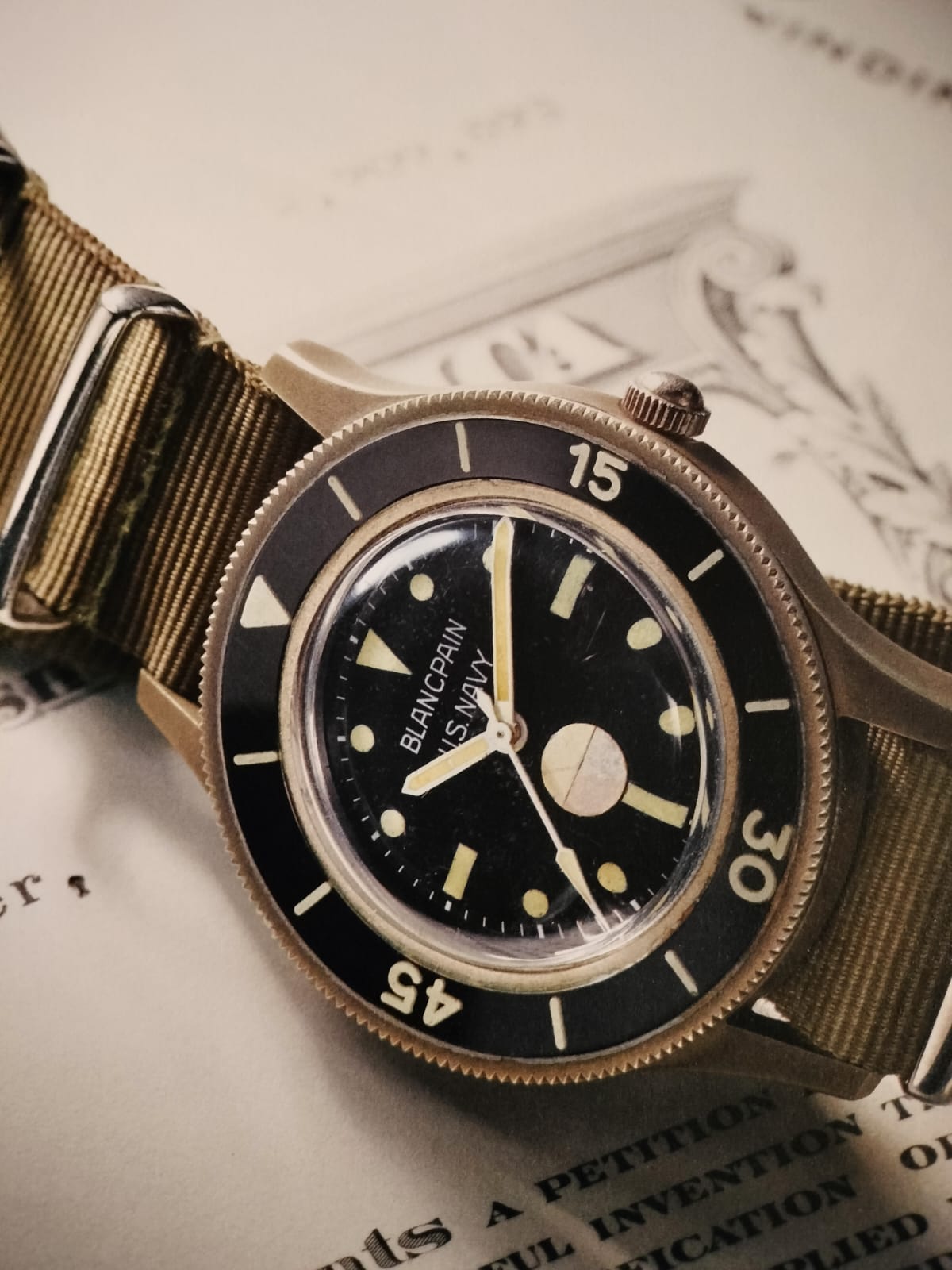
Blancpain Fifty FathomsPhoto by EMore98 (Wikimedia Commons), CC BY-SA 4.0 (source)

What is the Blancpain Fifty Fathoms?

The Blancpain Fifty Fathoms is the first modern dive watch — released 1953, narrowly predating the Rolex Submariner. Developed for the French Navy's Nageurs de Combat (combat divers). The original spec called for 50 fathoms (91.45m) water resistance; modern references run to 300m. Current production: Fifty Fathoms 5015 ($15,400 in steel), Fifty Fathoms Bathyscaphe ($14,000, smaller 38-43mm variant), and limited 70th-anniversary reissues. In-house Caliber 1315 with three-day power reserve.

Origin

In 1952, French Navy Captain Robert "Bob" Maloubier and Lieutenant Claude Riffaud — both combat divers in the Nageurs de Combat unit — needed wristwatches that could support tactical underwater operations. The watches available at the time were inadequate. Maloubier and Riffaud specified what they needed: 50-fathom water resistance, anti-magnetic case, unidirectional rotating bezel for measuring dive time (with accidental rotation always indicating shorter remaining time, never longer), screw-down crown, large legible numerals readable in murky water, and luminescent markings.

They approached major Swiss watchmakers. Most refused — the requirements were too demanding for the small order quantities. Blancpain CEO Jean-Jacques Fiechter agreed to take the project. Fiechter was himself a recreational diver and understood the engineering requirements personally. The first Fifty Fathoms entered service with the French Navy in early 1953, predating the Rolex Submariner debut at Baselworld 1954.

We needed a watch our divers could trust. We didn’t have one. Blancpain made one. That was ‘fifty fathoms’ — the depth our missions required.

Captain Robert Maloubier, French Combat Diving School, 1953
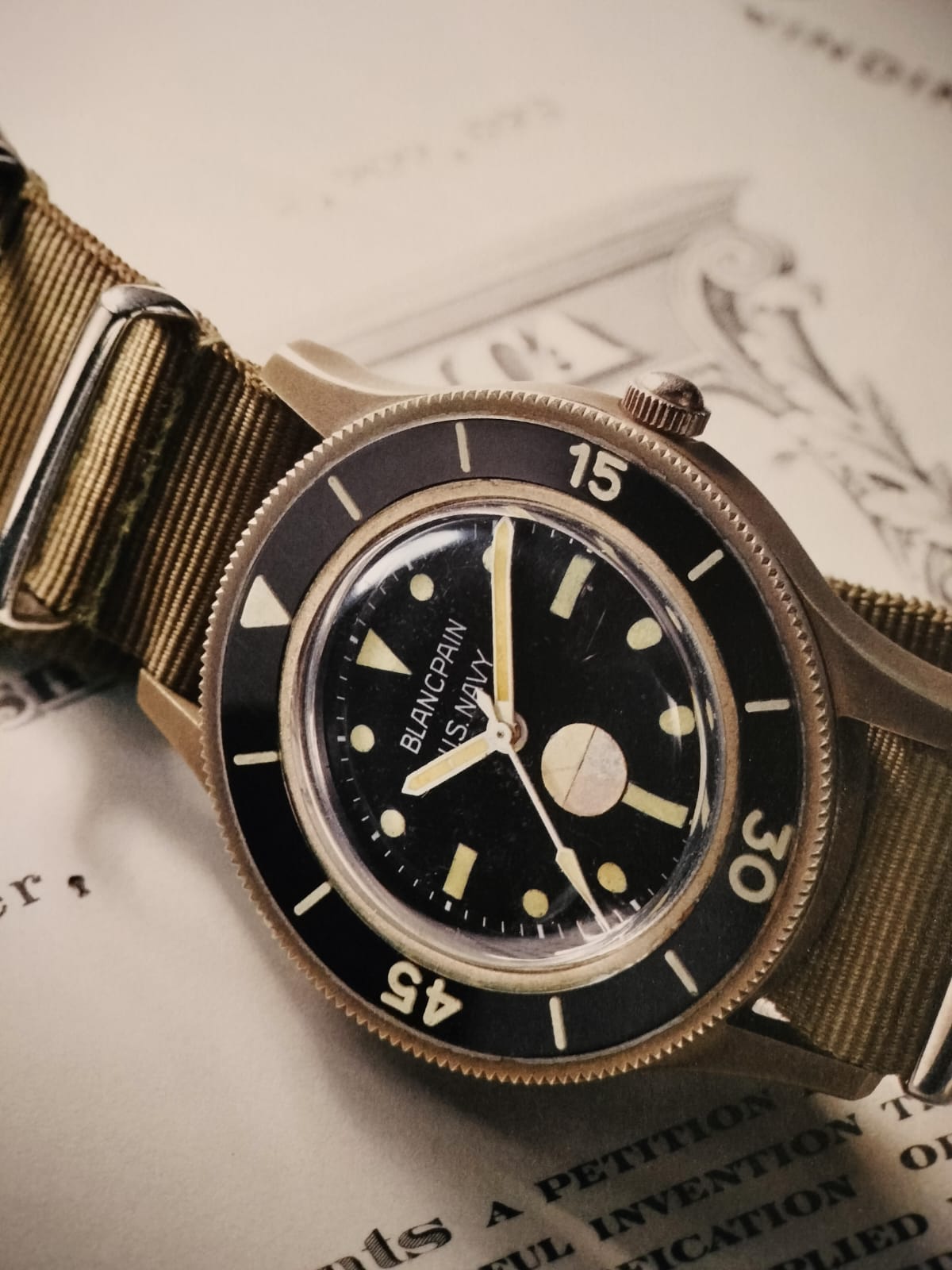
Blancpain — Fifty Fathoms Mil-Spec (US Navy SEALS)
Photo by EMore98 (Wikimedia Commons), CC BY-SA 4.0 (source)

Mil-Spec and SEALs

The 1957 Mil-Spec Fifty Fathoms was the military-issued reference adopted by US Navy SEALs and the German Bundesmarine. The watch added a moisture indicator at six o’clock — a small humidity gauge that turned color if the case seal was breached. The Mil-Spec ran in service through the 1960s and 1970s and is the reference most prized by vintage collectors today.

The 1957 Mil-Spec Fifty Fathoms was issued to US Navy SEALs and German Bundesmarine. The watch existed because military divers needed it before recreational divers knew they wanted one.

Modern collection

  • Fifty Fathoms 5015 — 45mm steel, 300m WR, in-house Caliber 1315, $15,400. The reference Fifty Fathoms.
  • Fifty Fathoms Bathyscaphe — 38mm or 43mm, 300m WR, in-house Caliber 1150 or 1315, $14,000-$16,000. The smaller, dressier variant. Fifty Fathoms aesthetic in a more wearable size.
  • Fifty Fathoms 70th Anniversary Acts I-III — 2023-2024 limited editions referencing specific historical Fifty Fathoms variants. Limited production; allocation controlled.
  • Fifty Fathoms Tribute — Reference 5008B-1130-B52A. Vintage-inspired reissue with the original 1953 dial layout. Limited.
  • Air Command (related) — chronograph reissue, $18,800. Not a Fifty Fathoms but shares dive-watch DNA.
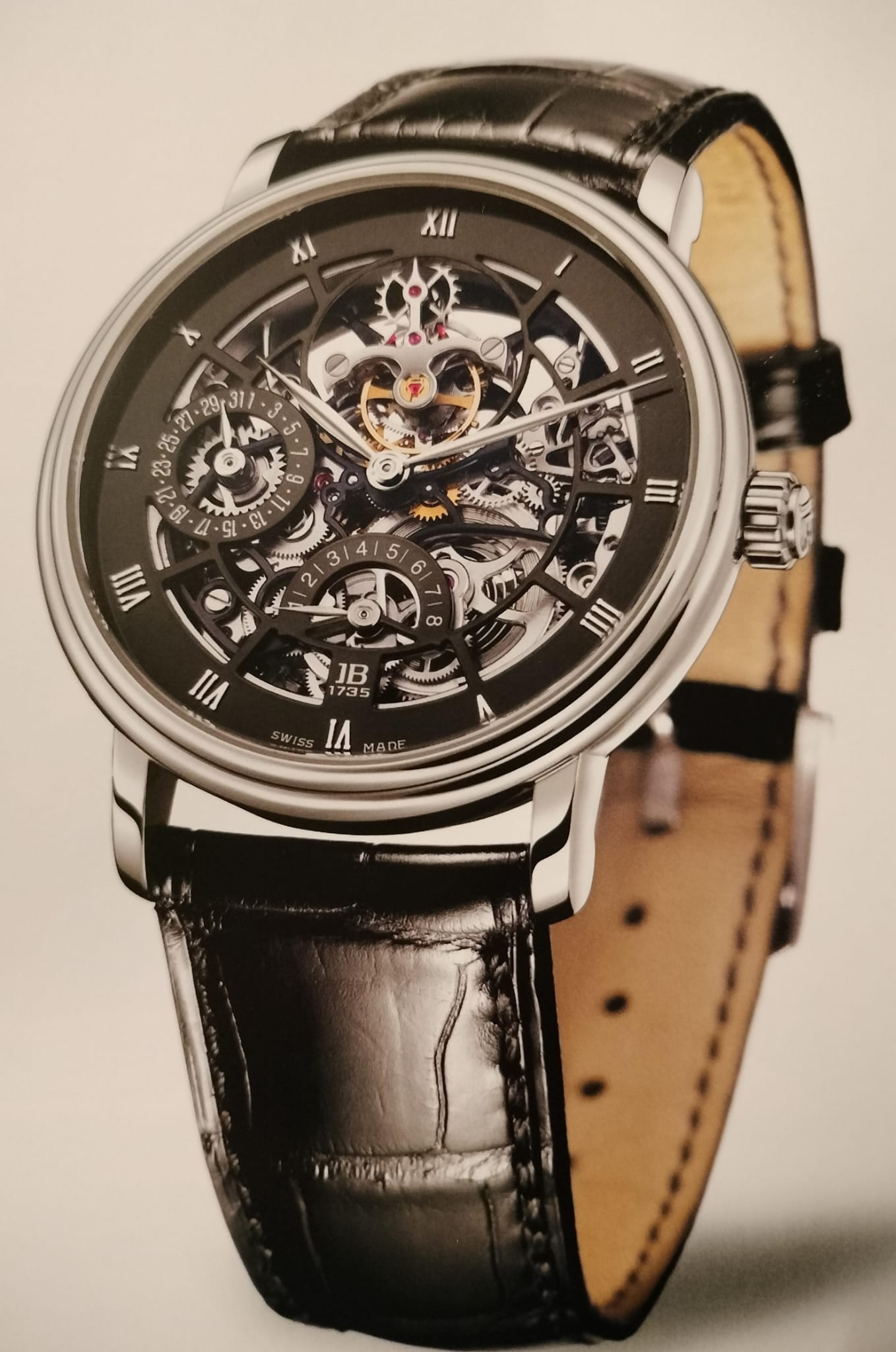
Blancpain — Villeret ref. 6025 tourbillon (1998)
Photo by EMore98 (Wikimedia Commons), CC BY-SA 4.0 (source)

What's worth knowing

The Fifty Fathoms' historical priority over the Submariner is well-documented but rarely emphasized in mainstream watch culture. Among horology historians and serious collectors, the Fifty Fathoms is recognized as the founding modern dive watch. Among the broader public, the Submariner is more recognized because Rolex marketed it more aggressively and it appeared in more films (Bond) and cultural moments.

Blancpain's ocean-conservation positioning is unusually integrated. The brand sponsors the Blancpain Ocean Commitment program — funding marine biology research and conservation. Co-branded Fifty Fathoms references support the program. The positioning predates the broader luxury industry's sustainability turn.

Read more

Frequently Asked

On the Fifty Fathoms

Is the Fifty Fathoms older than the Submariner?

Yes — narrowly. The Blancpain Fifty Fathoms entered service with the French Navy in early 1953; the Rolex Submariner debuted at Baselworld in early 1954. Both watches independently developed the rotating dive bezel, screw-down crown, and luminescent dial markings that define the modern dive watch. The Fifty Fathoms was a military commission for the Nageurs de Combat (French combat divers); the Submariner was a commercial product. Most horology historians credit the Fifty Fathoms as the first modern dive watch.

Why is it called "Fifty Fathoms"?

Fifty fathoms = 91.45 meters water resistance — the depth specification the French Navy demanded from Blancpain. The watch was developed in 1952 by French Navy combat divers Captain Robert "Bob" Maloubier and Lieutenant Claude Riffaud, who worked with Blancpain CEO Jean-Jacques Fiechter to specify the watch. Fiechter was himself a recreational diver and understood the engineering requirements personally. The original 1953 watches met the 50-fathom spec; modern Fifty Fathoms references run to 300m (300 meters / 984 feet).

Did the Fifty Fathoms predate the rotating bezel concept?

It was the first to use the unidirectional rotating bezel for dive timing. Earlier dive-style watches (Omega Marine, 1932; Rolex Oyster, 1926) had water-resistant cases but lacked the dive-bezel timing function. The Fifty Fathoms' unidirectional rotating bezel — which only turns counterclockwise — was specifically chosen so accidental rotation would always indicate less remaining dive time, never more. The convention has been universal in dive watches ever since.

Which Fifty Fathoms should I buy?

Modern Fifty Fathoms 5015 ($15,400 in steel) — 45mm, 300m water resistance, in-house Caliber 1315 with three-day power reserve. Fifty Fathoms Bathyscaphe ($14,000) — 38-43mm cases, smaller and dressier variant. Fifty Fathoms Tribute series — vintage-inspired reissues at limited production. Fifty Fathoms 70th Anniversary Acts (2023, releases tied to specific historical references). Buyers focused on the historical significance pick the standard Fifty Fathoms; buyers focused on wearability often pick the Bathyscaphe.

What is The Essential Watch Guide?

The Essential Watch Guide is an editorial publication covering luxury watchmaking — Swiss heritage houses, dive watches, vintage timepieces, and the makers worth knowing. Coverage includes Rolex, Patek Philippe, Audemars Piguet, Vacheron Constantin, Omega, Tudor, and dozens more. Editorial focus: history, signature collections, what to look for when buying, and how value holds.

Which Swiss watch brands are the most prestigious?

The "Holy Trinity" of Swiss watchmaking is Patek Philippe (founded 1839), Audemars Piguet (1875), and Vacheron Constantin (1755) — the three houses widely considered the apex of haute horlogerie. Rolex is the most recognized worldwide; Jaeger-LeCoultre supplies movements to many top brands; Blancpain is the oldest continuously operating watchmaker (founded 1735). Independent makers like F.P. Journe and Richard Mille operate at the same tier with smaller production runs.

What makes a watch "Swiss made"?

Swiss law requires that a watch labeled "Swiss made" must have its movement assembled in Switzerland, its movement cased in Switzerland, undergone final inspection by the manufacturer in Switzerland, and have at least 60% of its production cost incurred in Switzerland. The standard is enforced by the Federal Council and the Federation of the Swiss Watch Industry FH.