
 Photo by Verygoodlord, via Wikimedia Commons, CC BY-SA 4.0
 What is the best Swiss watch brand?
There is no single answer. For investment-grade prestige and auction performance, Patek Philippe leads — seven of the ten most expensive watches ever sold at auction are Patek. For recognition, value retention, and the most complete tool-watch catalog, Rolex is unmatched. For limited production at the apex of haute horlogerie, Audemars Piguet, Vacheron Constantin, and Patek form the "Holy Trinity." The right answer depends on what you value: legacy, finishing, design influence, or movement complexity.
A guide to luxury Swiss watchmaking
A Swiss luxury watch is a piece of mechanical history finished by hand. The craftsmen and women who build them train for years, sometimes decades. The materials are aerospace-grade or precious; the movements have been tested, refined, and reissued across generations. A high-end Swiss watch is not a timepiece in the practical sense — your phone tells time. It is an object that holds value across decades, communicates taste, and rewards the closer look.
Owning a Swiss watch signals more than wealth. It signals that the wearer cares about how things are made — that mechanical precision, hand-applied finishing, and the quiet labor of skilled artisans matter to them. The market reflects this. The best pieces hold value across decades. The exceptional pieces appreciate.
When considering a Swiss watch, it pays to know the major houses: who founded them, what they invented, what they make now. Some names — Rolex, Patek Philippe — are recognized worldwide. Others — Vacheron Constantin, Blancpain, Jaeger-LeCoultre — are quieter but sit at the same tier or higher. Understanding the differences is the difference between buying a watch and choosing one.
Why Swiss watches hold their value
Swiss watches retain value for ten reasons that compound:
- Heritage. A watch from a Swiss maker founded in the 18th or 19th century carries documented continuous production. That continuity is itself a premium.
- Materials. The best Swiss watches use aerospace-grade alloys, precious metals, sapphire, ceramic, and carbon composites. Cases are machined to tolerances measured in microns.
- Hand-finishing. Movements are decorated by hand — Côtes de Genève, perlage, anglage. The Geneva Seal and Patek Seal certify standards of finishing that machines cannot replicate.
- Tested complications. Perpetual calendars, minute repeaters, tourbillons, split-seconds chronographs — every complication has been refined across generations.
- Limited production. Patek Philippe produces around 70,000 watches a year. Vacheron Constantin makes about 20,000. Audemars Piguet produces 40,000. Scarcity is structural, not artificial.
- Design longevity. The Royal Oak (1972), the Submariner (1953), and the Calatrava (1932) still look modern half a century later.
- Aesthetic discipline. Swiss watch design is restrained. Dials are legible, cases are proportionate, and changes happen slowly across decades.
- Cultural signaling. A Patek or a Rolex communicates classical taste in a way few objects can match.
- Conversation. Watch enthusiasts find each other. A good Swiss watch starts conversations the wearer could not have anticipated.
- Heirloom logic. "You never actually own a Patek Philippe. You merely look after it for the next generation," reads the brand's 1996 slogan. The line works because it is true.
The major Swiss houses
Price is not a perfect proxy for quality, but the most expensive Swiss watches cost what they cost for reasons. Hand-finishing, brand history, in-house movement development, and limited production all compound. The houses below are listed in the order they established themselves at the top of the market — not by founding date.
F.P. Journe
Founded 1999 in Geneva. F.P. Journe is the only Swiss watch manufacturer to have won the Aiguille d'Or — the Grand Prix d'Horlogerie de Genève's top prize — more than twice. The brand is the only luxury watchmaker still headquartered in central Geneva, in the Coulouvrenière Rois district. Its motto is Invenit et Fecit— "he invented it and made it" — a claim few watchmakers can make in full. F.P. Journe designs and produces nearly every component in-house, including its own cases (via Les Boîtiers de Genève) and dials (via Les Cadraniers de Genève). The Chronométre Bleu, Octa, Centigraphe, and Linesport collections are the entry points; the Astronomic Souveraine and Tourbillon Souverain Vertical define the upper register.
Richard Mille
Founded 1999, first watch (RM 001) released 2001. Richard Mille watches are tonneau-shaped, frequently skeletonized, and use materials borrowed from Formula 1 and aerospace. The brand operates in ultra-luxury — entry pieces start near $80,000; flagship pieces routinely exceed $1 million. Jay-Z wore a $2.5 million custom Richard Mille (sapphire case, 3,000+ hours of production) to the NAACP awards. The founder's design thesis is contrarian: lightweight luxury watches with mechanical visible at every angle, no gemstones on the bezel. "If you want a watch with diamonds on the bezel, you don't need me," Mille has said.
Patek Philippe
Founded 1839. Family-owned by the Sterns since 1932. Patek Philippe is the most honored name in haute horlogerie — seven of the ten most expensive watches ever sold at auction are Patek. The house produces its own movements, holds over 100 patents, and has invented more than 20 base calibers. In 2009 Patek withdrew from the Geneva Seal to launch the stricter Patek Philippe Seal, applied to the entire watch rather than just the movement (precision +3/-2 seconds for diameters 20mm and over). Production is small: around 70,000 watches a year. A basic Patek takes up to ten months to make; the most complicated pieces require up to 2.5 years. The 1996 slogan — "You never actually own a Patek Philippe. You merely look after it for the next generation" — has held since the day it was written. Models worn by Queen Victoria, Tolstoy, Marie Curie, Picasso, JFK, and Tchaikovsky.
Audemars Piguet
Founded 1875 in Le Brassus, Vallée de Joux. Family-owned across four generations. AP's historical record: the first minute-repeating wristwatch movement (1892), the first jumping-hour wristwatch (1921), the first skeleton watch (1934), and the world's thinnest automatic perpetual calendar (2019). The 1972 Royal Oak — steel sport watch, integrated bracelet, exposed screws — broke every Swiss convention of its decade and remains the brand's signature. Production runs around 40,000 pieces a year. Worn by LeBron James, Lionel Messi, Serena Williams, and members of multiple royal families.
Vacheron Constantin
Founded 1755. The oldest continuously operating watch manufacturer. Production: about 20,000 pieces a year, made in Plan-les-Ouates (Geneva) and the Vallée de Joux. The house created the first watch complication in 1790. Reference 57260 — completed in 2015 after eight years of development — holds the record for the world's most complicated mechanical watch with 57 horological complications. Pocket watch No. 402833, once owned by King Fuad I of Egypt, sold for $2.77 million at auction in 2005. Motto: Faire mieux si possible, ce qui est toujours possible— "Do better if possible, and that is always possible." The Overseas, Patrimony, Métiers d'Art, and Tour de l'Île define the modern catalog.
A. Lange & Söhne
German, not Swiss — but routinely listed alongside the Holy Trinity for finishing quality. Founded 1845 in Glashütte by Ferdinand Adolph Lange. Refounded 1990 by Walter Lange after East German nationalization disrupted the family company. Current lines: Lange 1, Zeitwerk, Saxonia, 1815, Richard Lange, Odysseus. Around 5,000 watches a year, all movements designed and assembled in Glashütte with no outsourcing. Mottos: Walter Lange's "Never Stand Still" and the corporate "State of the Art Tradition." A Lange & Söhne 1815 Homage to Walter Lange in stainless steel sold for $852,000 in 2018.
Jaeger-LeCoultre
Founded 1833. Part of the Richemont Group. JLC holds over 100 patents and has produced more than 1,000 distinct watch movements. The house designed the world's smallest watch movement, the Atmos clock with near-perpetual movement (powered by atmospheric temperature variation), the Millionomètre (which measured microns in the 19th century), and the Hybris Mechanica Grande Sonnerie — one of the most complicated wristwatches ever produced. Current lines: Reverso, Master Ultra Thin, Polaris, Memovox, Geophysic, Atmos. Worn by Bill Clinton, Queen Elizabeth II, Charlie Chaplin, and Amelia Earhart. JLC supplies movements to other top brands — a structural fact often left unsaid in their marketing but well-known in the industry.
Rolex
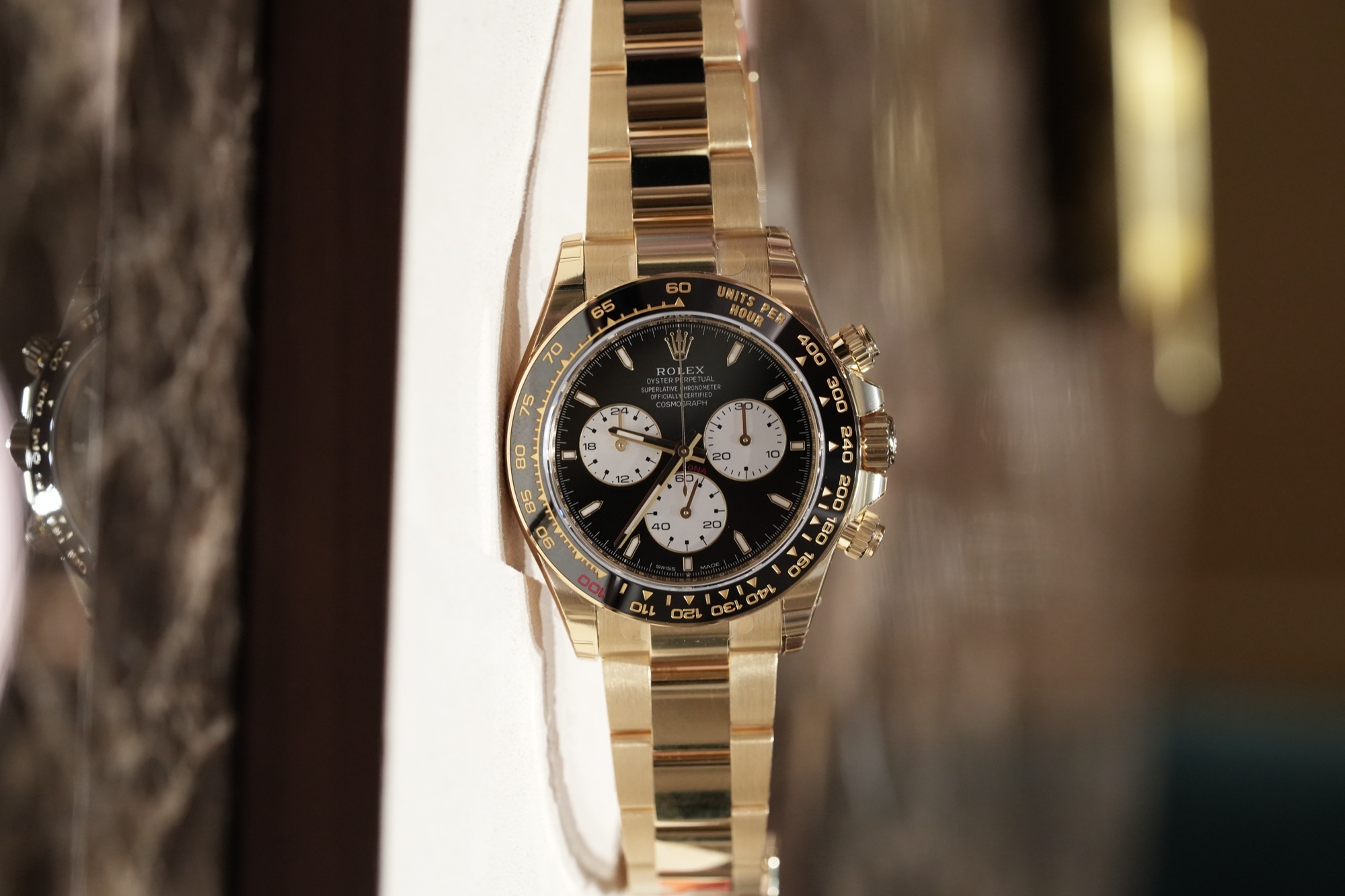
Founded 1905. The most recognized watch brand in the world. Production: over 2,500 watches per day — by far the largest Swiss-made chronometer manufacturer. Rolex is ranked the 71st most valuable brand globally by Forbes. Three of the ten most expensive watches ever sold at auction are Rolexes; Paul Newman's personal Daytona sold for $17.7 million in 2017. The catalog is structured around professional collections: Submariner (diving), GMT-Master (aviation), Explorer (mountaineering), Yacht-Master (sailing), Daytona (motorsport). Sponsorships include Wimbledon, the U.S. Open, two PGA majors, and the 24 Hours of Daytona. The brand's motto — A Crown for Every Achievement — frames the catalog as a series of milestones rather than a price list.
Breguet
Founded 1775. Located in L'Abbaye, Switzerland. Abraham-Louis Breguet invented the tourbillon, the world's first self-winding watch, and the very first wristwatch. The Breguet & Fils Paris No. 2667 pocket watch sold for $4.69 million; the Breguet Sympathique Clock No. 128 & 5009 sold for $6.8 million. Marie-Antoinette's pocket watch — commissioned 1783, finished 1827 — is one of the most complicated pieces ever produced. Patrons across Breguet's history include Napoleon, Winston Churchill, and Ettore Bugatti. Signature design elements: coin-edge cases, guilloché dials, and the "Breguet hands" with their hollow apple tips. The Reine de Naples collection brought the motto "Every woman is a queen" into the modern catalog.
Blancpain
Founded 1735. The oldest continuously operating watchmaker in the world. Best known for the Fifty Fathoms (1953) — one of the first modern dive watches, predating the Rolex Submariner — and the 1735 Grande Complication (1991). Blancpain also produced the first automatic wristwatch. The corporate motto is unambiguous: "Blancpain has never made a quartz watch and never will." The house has held to it. No quartz, no digital displays, fewer than thirty pieces produced per day. Replaces Grand Seiko in our Swiss-makers coverage because Grand Seiko, despite its parallel quality, is Japanese.
Roger Dubuis
Founded 1995. Production: 5,000–5,500 pieces a year. All calibers and most components produced in-house in Geneva. The Excalibur collection — double tourbillon skeleton movement — is the brand signature. Motorsport collaborations with Lamborghini, Squadra Corse, and Pirelli (with race-tire material inlays) define the modern direction. Aesthetics are aggressive — the brand operates in a register closer to Richard Mille than to Patek.