
Skip to content
Maker profile · Le Brassus · Founded 1875

Audemars Piguet The Royal Oak legacy.

11 min readPublished

The house that broke every Swiss convention in 1972 with a steel sport watch on a steel bracelet — and built modern luxury watchmaking as we know it.

Audemars Piguet Royal Oak case detailMagnus26, CC BY-SA 3.0, via Wikimedia Commons (source)

What is Audemars Piguet?

Audemars Piguet is a Swiss luxury watch manufacturer founded 1875 in Le Brassus, Vallée de Joux. Family-owned across four generations. Annual production: about 40,000 watches. The 1972 Royal Oak — designed by Gérald Genta in a single night before Baselworld — defined the modern luxury sport watch. AP sits in the "Holy Trinity" of haute horlogerie alongside Patek Philippe and Vacheron Constantin. Inventions include the first minute-repeating wristwatch movement (1892), the first jumping-hour wristwatch (1921), the first skeleton watch (1934), and the world's thinnest automatic perpetual calendar (2019).

History

Jules-Louis Audemars and Edward-Auguste Piguet were both watchmakers in Le Brassus, the Vallée de Joux village where AP is still headquartered. Both came from watchmaking families. They formed the company in 1875 — Audemars handling production, Piguet handling commerce. By 1882 they had produced their first "grande complication" pocket watch. The Vallée de Joux became the technical home of haute horlogerie partly because AP was there.

The technical record is unusually consequential. AP produced the first minute-repeating wristwatch movement in 1892 (the Caliber 13"'Y) — a movement that sounds the hours, quarters, and minutes on demand. The first jumping-hour wristwatch came in 1921. The first skeleton watch was made in 1934. The first ultra-thin tourbillon wristwatch (Caliber 2870, 1986) was 4.8mm thick — at the time the thinnest tourbillon wristwatch ever made.

The Royal Oak is the moment that changed everything. By 1971 the Swiss watch industry was under siege — the "quartz crisis" was decimating mechanical watchmakers, and the Vallée de Joux was particularly exposed. Georges Golay, AP's managing director, gave Gérald Genta a single night to design a stainless steel sport watch for the Italian market. Genta drew the eight-screw bezel that night, inspired by a deep-sea diving helmet. The watch debuted at Baselworld 1972 priced at SFr 3,300 — more than a gold Rolex Datejust at the time. Critics called it commercially ruinous; collectors called it brilliant. The Royal Oak saved AP and arguably saved the entire haute horlogerie segment from the quartz collapse.

I drew the watch in a single night. The eight visible screws were the diving helmet — what made the Royal Oak the Royal Oak.

Gérald Genta, on the Royal Oak design night, 1971

In 1993 Emmanuel Gueit (then 22) designed the Royal Oak Offshore — a larger, sportier evolution at 42mm with a chronograph and rubber gasket between bezel and case. AP traditionalists hated it. The market loved it. The Offshore became the brand's second signature.

Signature collections

Royal Oak

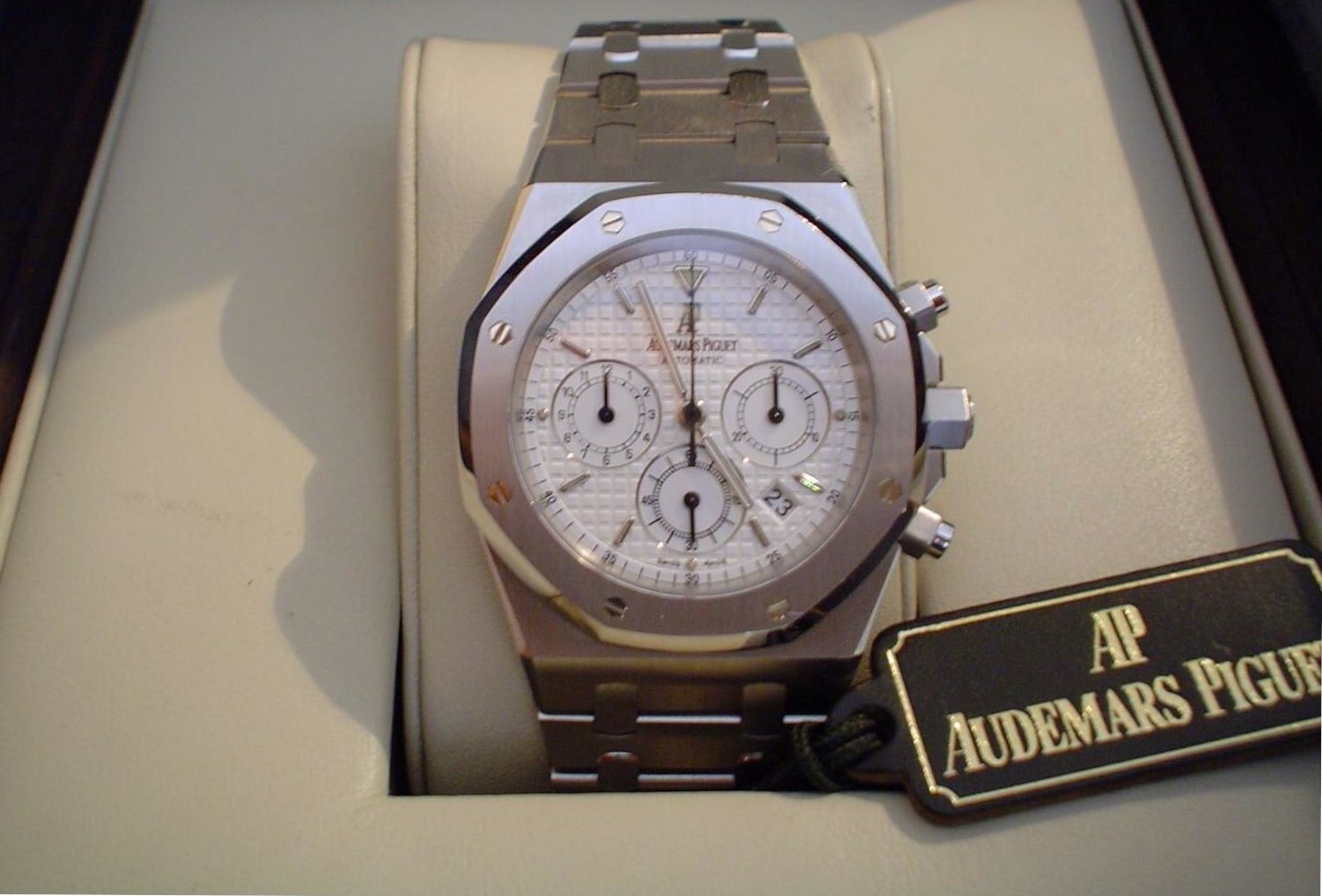
Released 1972. Genta's eight-screw octagonal bezel, integrated tapered bracelet, Grande Tapisserie dial pattern. Modern Royal Oak references run from the 39mm Jumbo Extra-Thin 16202ST ($35,400 retail, $80,000+ secondary) to 41mm Selfwinding 15500ST ($25,800), Chronograph 26240ST ($43,800), and Perpetual Calendar 26574 ($110,400). Material variants include yellow gold, white gold, rose gold, platinum, and frosted gold. Steel allocation is the most constrained.

Audemars Piguet — Royal Oak Jumbo 15202
OpaleHorse, CC BY-SA 4.0, via Wikimedia Commons (source)

Royal Oak Offshore

Released 1993. Larger case, chronograph movements, sportier proportions. Modern Offshore Chronograph 26420 ($43,200 in steel) and Diver 15720 ($25,400) anchor the line. Limited editions tied to motorsport (Michael Schumacher, Marvel) and collaborations with celebrities (LeBron James, Travis Scott) are routine. The Offshore is louder than the original Royal Oak — bigger, more material variation, more lume. Both pieces share the design DNA but answer different aesthetic questions.
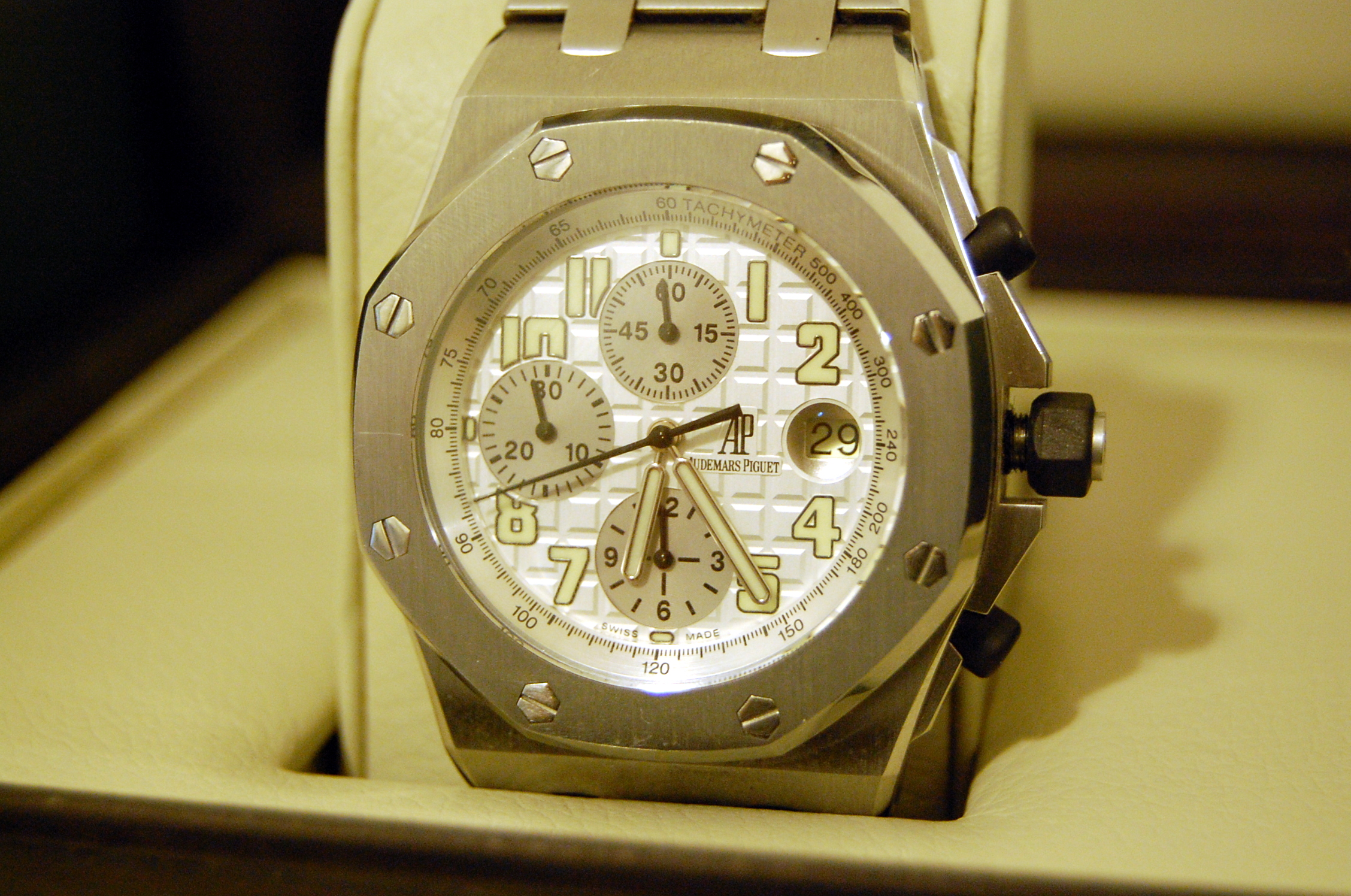
Audemars Piguet — Royal Oak Offshore
CC BY 3.0, via Wikimedia Commons (source)

The Royal Oak was the rule. The Offshore was the deliberate breaking of it.

Royal Oak Concept

Released 2002. The technical and material flagship. Forged carbon cases, sapphire cases, ceramic cases, skeletonized movements, tourbillons, minute repeaters, GMT. Concept pieces start around $200,000 and reach over $1 million. The Concept Frosted Gold Flying Tourbillon Openworked (~$240,000) and the Code 11.59 Universelle Concept (~$1M+) are recent examples.

Code 11.59

Released 2019. AP's first new collection in 25 years. Round case (a departure from the Royal Oak octagon), fluted middle case lugs, complex movements. The launch was poorly received aesthetically — collectors had expected something to rival the Royal Oak's impact. Subsequent references (the Universelle Grand Complication, the Selfwinding Chronograph in white gold) have improved the line's standing. Code 11.59 Selfwinding starts at $26,500.

Jules Audemars

Round dress watches in the more traditional AP house style. Less recognized than the Royal Oak but worth knowing — the Jules Audemars Grande Sonnerie Carillon Supersonnerie (2016) reimagined acoustic watchmaking with a new sound-engineering approach. Most Jules Audemars references are precious metal and run $40,000+.

Price tiers

  • Entry — Code 11.59 Selfwinding ($26,500), Royal Oak 37mm ($24,000-$28,000)
  • Mid — Royal Oak Selfwinding 15500ST ($25,800), Royal Oak Chronograph 26240ST ($43,800), Royal Oak Offshore Diver 15720 ($25,400)
  • Sport flagship — Royal Oak Jumbo Extra-Thin 16202ST ($35,400), Royal Oak Perpetual Calendar 26574 ($110,400), Royal Oak Offshore Chronograph 26420 ($43,200)
  • Concept — Forged carbon, ceramic, skeletonized, tourbillons, repeaters. $200,000-$1M+
  • Collector — Vintage Royal Oak A-series (1972-1976), discontinued steel "Jumbo" 5402, John Mayer collaborations, Michael Schumacher Offshore. Six and seven figures.

What's worth knowing

The Royal Oak case is hand-finished. The flat surfaces are mirror-polished; the chamfers are hand-beveled; the brushed surfaces require approximately 30 hours of finishing per case. The bracelet alone takes hours of articulated finishing — each link is hand-finished before assembly. This is why production is small even for a brand at AP's commercial scale. The labor doesn't reduce.

In-house movements: the 4400 chronograph caliber (introduced 2015), the 5135 perpetual calendar caliber, the 7121 Selfwinding caliber (2022 — replacing the long-running 3120). AP supplies movements internally and does not sell calibers to other brands — unlike Jaeger-LeCoultre, which has historically been a movement supplier to the wider industry. AP's independence on movement design is a structural difference.

Worn by LeBron James, Lionel Messi, Serena Williams, Jay-Z, John Mayer, Tom Brady, Arnold Schwarzenegger, and members of multiple royal families. AP's celebrity positioning is the most visible of the Trinity. The brand leans into it more consciously than Patek (which keeps a quieter cultural register) or Vacheron (which is structurally invisible to most non-collectors).

For the rest of the Trinity:

For Genta's other masterwork:

For the broader survey:

Frequently Asked

On Audemars Piguet

How many Audemars Piguet watches are made each year?

Audemars Piguet produces approximately 40,000 watches per year. The Royal Oak family accounts for the majority of production. Production is constrained by the hand-finishing standards Le Brassus maintains — particularly the Royal Oak's hand-finished case and bracelet, which require approximately 30 hours of finishing per case alone.

Who designed the Royal Oak?

Gérald Genta designed the Royal Oak for Audemars Piguet in 1971, presented at Baselworld 1972. Genta was 25 years old. He produced the design in a single night before the Basel deadline, drawing inspiration from the helmet of a deep-sea diver — particularly the eight visible screws on the bezel that mimicked the diving helmet's bolts. Genta later designed the Patek Philippe Nautilus (1976), the IWC Ingenieur, the Bvlgari Bvlgari, and others. The Royal Oak is generally considered his most influential work.

What is the difference between Royal Oak and Royal Oak Offshore?

The Royal Oak (1972) is the original — 39mm or 41mm case, slim profile, integrated bracelet, Tapisserie dial. The Royal Oak Offshore (1993, designed by Emmanuel Gueit when he was 22) is the larger, sportier evolution — 42mm or 44mm cases, chronograph movements, often with rubber straps and bolder dial colors. The Offshore turned the Royal Oak into a category — bigger, more aggressive, more material variation. The original Royal Oak remains the more elegant choice; the Offshore is the louder one.

What is the Royal Oak Concept?

The Royal Oak Concept is the brand's technical-flagship variant — released 2002 for the Royal Oak's 30th anniversary. Features include skeletonized dials, advanced materials (forged carbon, ceramic, sapphire cases), and complications like tourbillons, GMT, flying tourbillons, and minute repeaters. Concept pieces routinely run $200,000 to over $1 million. The Concept Black Panther Flying Tourbillon (2021) and the Concept Frosted Gold Flying Tourbillon Openworked are recent examples.

Is the Royal Oak still hard to buy?

Yes, especially the steel Royal Oak Selfwinding 15500ST and 15510ST. Authorized-dealer waitlists run multiple years. Secondary market premiums sit at $35,000-$50,000 over the $25,800 retail. The 39mm "Jumbo" Royal Oak Extra-Thin 16202ST (released 2022 as a 50th-anniversary piece) trades around $80,000+ on the secondary market against $35,400 retail. Allocation favors long-standing Audemars Piguet clients with prior purchase history.

When did the Audemars family found the company?

Jules-Louis Audemars and Edward-Auguste Piguet founded the company in 1875 in Le Brassus, Vallée de Joux. Both were watchmakers. Audemars handled production; Piguet handled commercial relations. The company has remained in family hands across four generations — currently led by Olivier Audemars (Vice Chairman), the great-grandson of Jules-Louis. Le Brassus, the Vallée de Joux village where the company was founded and remains headquartered, has fewer than 1,500 residents.

What is Audemars Piguet?

Audemars Piguet is a Swiss luxury watch manufacturer founded 1875 in Le Brassus, Vallée de Joux. Family-owned across four generations. Annual production: approximately 40,000 watches. The 1972 Royal Oak — designed by Gérald Genta — defined the modern luxury sport watch and remains the brand's signature collection. Audemars Piguet sits in the "Holy Trinity" of haute horlogerie alongside Patek Philippe and Vacheron Constantin. Notable inventions include the first minute-repeating wristwatch movement (1892), the first jumping-hour wristwatch (1921), the first skeleton watch (1934), and the world's thinnest automatic perpetual calendar (2019).

How many Audemars Piguet watches are made each year?

Audemars Piguet produces approximately 40,000 watches per year. The Royal Oak family accounts for the majority of production. Production is constrained by the hand-finishing standards Le Brassus maintains — particularly the Royal Oak's hand-finished case and bracelet, which require approximately 30 hours of finishing per case alone.

Who designed the Royal Oak?

Gérald Genta designed the Royal Oak for Audemars Piguet in 1971, presented at Baselworld 1972. Genta was 25 years old. He produced the design in a single night before the Basel deadline, drawing inspiration from the helmet of a deep-sea diver — particularly the eight visible screws on the bezel that mimicked the diving helmet's bolts. Genta later designed the Patek Philippe Nautilus (1976), the IWC Ingenieur, the Bvlgari Bvlgari, and others. The Royal Oak is generally considered his most influential work.

What is the difference between Royal Oak and Royal Oak Offshore?

The Royal Oak (1972) is the original — 39mm or 41mm case, slim profile, integrated bracelet, Tapisserie dial. The Royal Oak Offshore (1993, designed by Emmanuel Gueit when he was 22) is the larger, sportier evolution — 42mm or 44mm cases, chronograph movements, often with rubber straps and bolder dial colors. The Offshore turned the Royal Oak into a category — bigger, more aggressive, more material variation. The original Royal Oak remains the more elegant choice; the Offshore is the louder one.

What is the Royal Oak Concept?

The Royal Oak Concept is the brand's technical-flagship variant — released 2002 for the Royal Oak's 30th anniversary. Features include skeletonized dials, advanced materials (forged carbon, ceramic, sapphire cases), and complications like tourbillons, GMT, flying tourbillons, and minute repeaters. Concept pieces routinely run $200,000 to over $1 million. The Concept Black Panther Flying Tourbillon (2021) and the Concept Frosted Gold Flying Tourbillon Openworked are recent examples.

Is the Royal Oak still hard to buy?

Yes, especially the steel Royal Oak Selfwinding 15500ST and 15510ST. Authorized-dealer waitlists run multiple years. Secondary market premiums sit at $35,000-$50,000 over the $25,800 retail. The 39mm "Jumbo" Royal Oak Extra-Thin 16202ST (released 2022 as a 50th-anniversary piece) trades around $80,000+ on the secondary market against $35,400 retail. Allocation favors long-standing Audemars Piguet clients with prior purchase history.

When did the Audemars family found the company?

Jules-Louis Audemars and Edward-Auguste Piguet founded the company in 1875 in Le Brassus, Vallée de Joux. Both were watchmakers. Audemars handled production; Piguet handled commercial relations. The company has remained in family hands across four generations — currently led by Olivier Audemars (Vice Chairman), the great-grandson of Jules-Louis. Le Brassus, the Vallée de Joux village where the company was founded and remains headquartered, has fewer than 1,500 residents.

What is The Essential Watch Guide?

The Essential Watch Guide is an editorial publication covering luxury watchmaking — Swiss heritage houses, dive watches, vintage timepieces, and the makers worth knowing. Coverage includes Rolex, Patek Philippe, Audemars Piguet, Vacheron Constantin, Omega, Tudor, and dozens more. Editorial focus: history, signature collections, what to look for when buying, and how value holds.

Which Swiss watch brands are the most prestigious?

The "Holy Trinity" of Swiss watchmaking is Patek Philippe (founded 1839), Audemars Piguet (1875), and Vacheron Constantin (1755) — the three houses widely considered the apex of haute horlogerie. Rolex is the most recognized worldwide; Jaeger-LeCoultre supplies movements to many top brands; Blancpain is the oldest continuously operating watchmaker (founded 1735). Independent makers like F.P. Journe and Richard Mille operate at the same tier with smaller production runs.

What makes a watch "Swiss made"?

Swiss law requires that a watch labeled "Swiss made" must have its movement assembled in Switzerland, its movement cased in Switzerland, undergone final inspection by the manufacturer in Switzerland, and have at least 60% of its production cost incurred in Switzerland. The standard is enforced by the Federal Council and the Federation of the Swiss Watch Industry FH.