
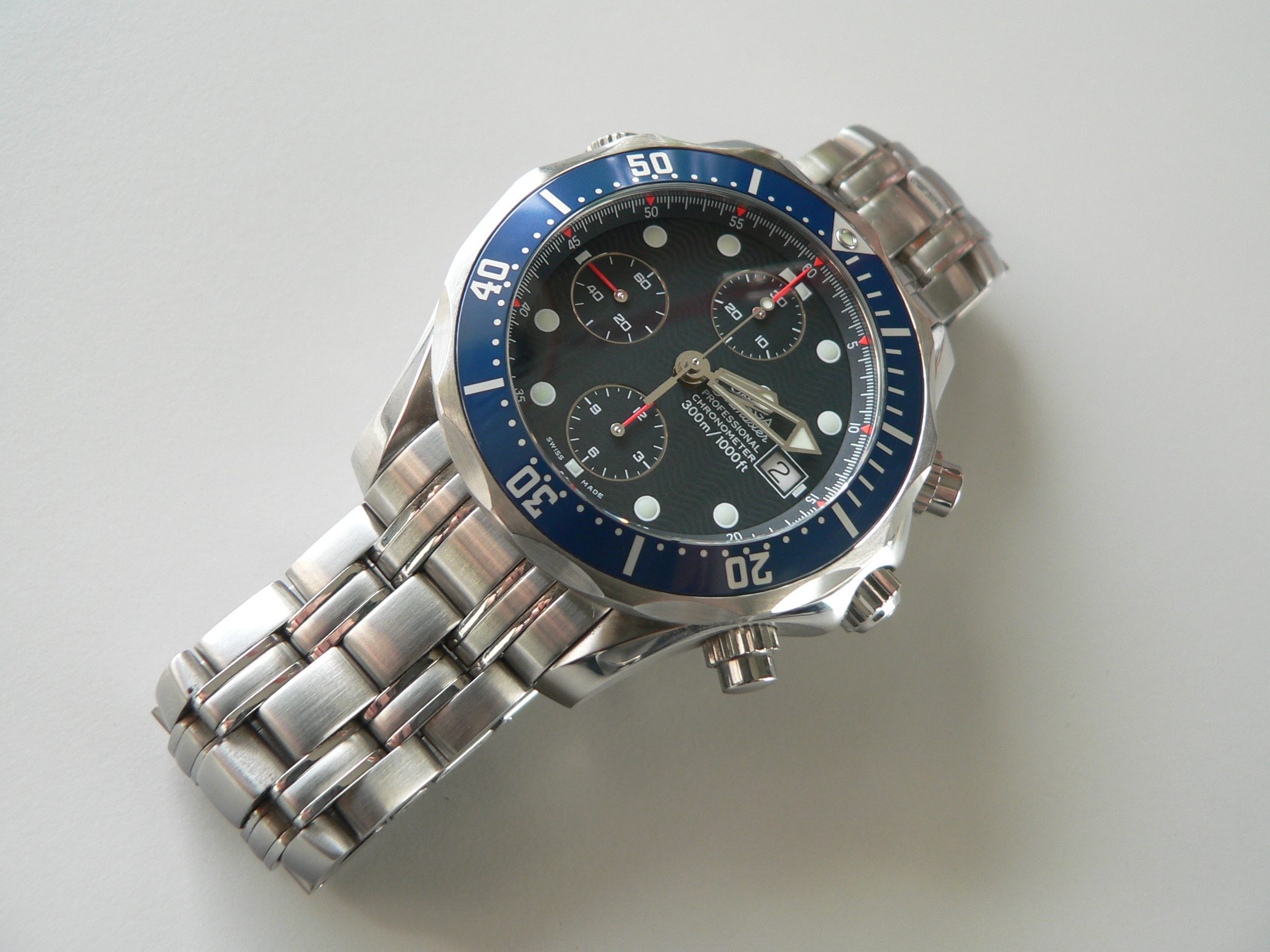
 Photo by Rama, via Wikimedia Commons, CC BY-SA 2.0 fr
 What is Omega?
Omega is a Swiss luxury watch manufacturer founded 1848 in La Chaux-de-Fonds, headquartered in Biel/Bienne since 1877. Production: roughly 600,000-700,000 watches per year. The Speedmaster Professional was the first watch worn on the moon (Buzz Aldrin, Apollo 11, 1969) and remains NASA-flight-qualified for crewed spaceflight. Omega pioneered the Co-Axial escapement in volume production (since 1999) and co-developed the Master Chronometer certification with METAS (since 2015). Part of the Swatch Group, alongside Breguet, Blancpain, and others.
History
Louis Brandt opened a watch-assembly workshop in La Chaux-de-Fonds in 1848. His sons moved the company to Biel/Bienne in 1877 and adopted modern industrial production — interchangeable parts, division of labor, and serial assembly. The Caliber 19''Omega — released 1894 — was the company's first calibre with truly interchangeable parts. The watch carrying it was so successful that the company eventually adopted the caliber name as the brand name. By 1903 the company was officially Omega.
The technical and cultural record is unusually broad:
- 1932 — First Omega Olympic timekeeping (Los Angeles Games); Omega has been the official Olympic timekeeper for most Games since
- 1948 — Seamaster collection released for the brand's 100th anniversary
- 1957 — Speedmaster, Seamaster, and Railmaster all released the same year — the "Big Three" sport-watch debut
- 1962 — Walter Schirra wears a Speedmaster on Mercury-Atlas 8 (first Speedmaster in space, a privately purchased piece)
- 1965 — NASA qualifies the Speedmaster as flight-rated for all manned space missions
- 1969 — Buzz Aldrin wears Speedmaster Professional ref. 105.012 on the lunar surface; the watch becomes the "Moonwatch"
- 1995 — Pierce Brosnan wears the Seamaster Diver 300M in GoldenEye; Omega becomes the official James Bond watch and has remained so
- 1999 — Co-Axial movement launches in volume production (Caliber 2500)
- 2015 — Master Chronometer certification launches with METAS
It was a watch I trusted. I left mine inside the lunar module — Neil’s was the one on the wrist on the surface.
Buzz Aldrin, on choosing the Speedmaster for Apollo 11
Signature collections
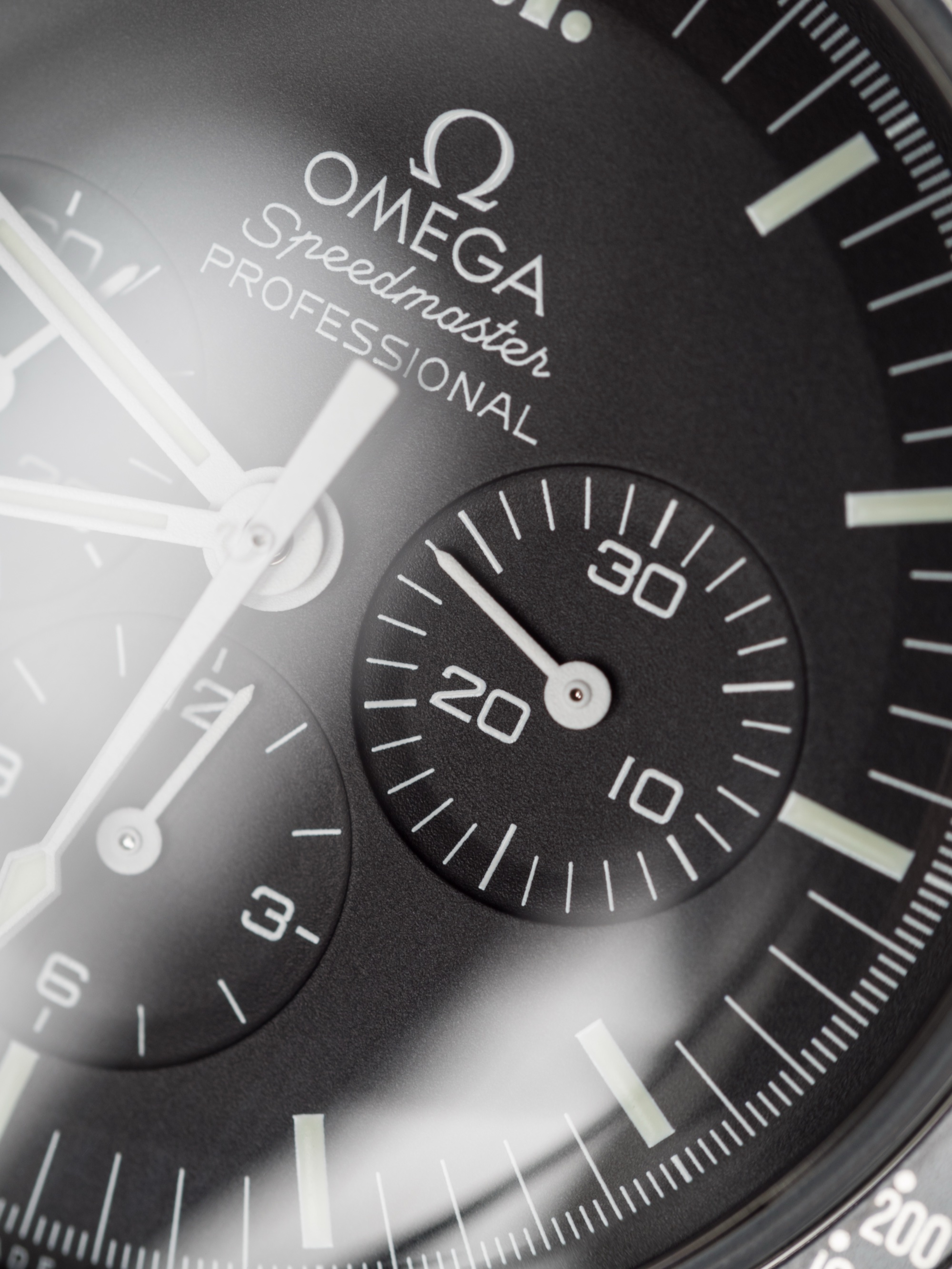
Speedmaster
The Moonwatch. Speedmaster Professional Moonwatch Co-Axial Master Chronometer Caliber 3861 ($7,400 hesalite, $7,800 sapphire) is the modern reference. The 42mm case, three sub-dials, tachymeter bezel, and manually wound movement preserve the 1957 design language. Speedmaster '57 (2024 redesign), Speedmaster Racing, Speedmaster Mark II reissue, and the Calibre 321 reissue extend the line. Limited editions tied to specific Apollo missions and NASA anniversaries appear regularly.
Seamaster
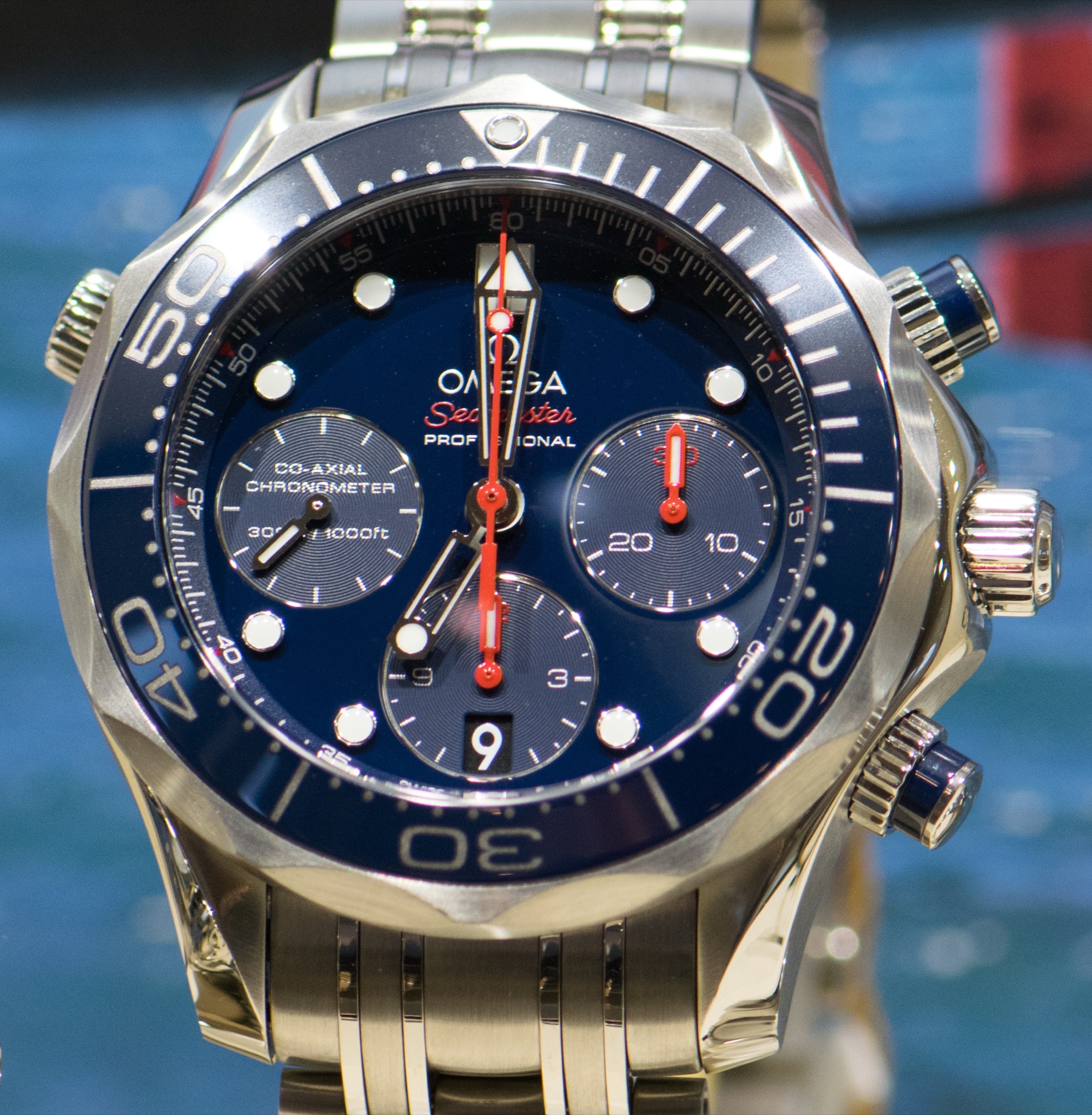
The dive collection. Seamaster Diver 300M Co-Axial Master Chronometer ($5,500-$5,800 in steel; up to $35,000 in gold) is the Bond watch. Seamaster Planet Ocean ($6,800-$8,800) is the larger, deeper-rated diver — 600m water resistance, helium escape valve, 43.5mm case. Seamaster Aqua Terra ($5,800-$6,400) is the dressier sport variant — no rotating bezel, "teak deck" dial pattern, dressier proportions. Seamaster Ploprof 1200m (the world's deepest serially produced dive watch at $11,300) sits at the technical end.
The Seamaster predates the Submariner by five years. The Bond connection is what made the modern reference cultural. The history was always there.
Constellation
The dress collection. Constellation Co-Axial Master Chronometer ($5,800-$15,000 depending on materials) — Roman numerals on the bezel, signature claw-shaped lugs, integrated bracelet. The most accessible Omega dress watch family. Constellation Globemaster ($7,800-$25,000) is the modern flagship — pie-pan dial, fluted bezel, vintage-inspired proportions.
De Ville
The classical dress collection. Hour Vision ($6,800-$45,000), Trésor ($5,800-$25,000), Prestige (entry $3,800), and the De Ville Tourbillon Co-Axial. The cleanest dial language Omega offers.
Railmaster
The anti-magnetic tool watch. Released 1957, reissued 2017. Railmaster ($5,200) — 40mm, fume dial, magnetic resistance to >15,000 gauss. The collection sits between Speedmaster and Aqua Terra in size and sport register. Limited production.
Price tiers
- Entry — Speedmaster '57 Co-Axial 38mm ($6,400), Seamaster Aqua Terra 38mm ($5,800), Railmaster ($5,200)
- Mid — Speedmaster Professional Moonwatch ($7,400-$7,800), Seamaster Diver 300M ($5,500-$5,800), Constellation Co-Axial ($5,800-$8,500)
- Flagship steel — Seamaster Planet Ocean Big Blue ($11,300), Speedmaster Calibre 321 reissue ($14,900), Seamaster Ploprof 1200m ($11,300)
- Precious metals — Speedmaster Apollo 11 50th Anniversary Yellow Gold ($35,000), Seamaster gold variants ($25K-$50K)
- Vintage / collector — Pre-1969 Speedmasters, original 1957 references, "Tropical" dial Speedies. $5K-$200K+
What's worth knowing
The Master Chronometer certification is the most stringent standard most modern luxury watches actually meet. A Master Chronometer Omega is COSC-certified and METAS-tested for accuracy under magnetic field exposure (15,000 gauss), pressure stability, and seven other criteria. Most Patek and AP movements are not certified to this standard — Omega's testing program is structurally more demanding than many higher-priced brands.
The Speedmaster occupies a unique cultural position. It is a $7,400 manual-wind watch produced in volume — but it was on the moon, and that fact has not changed. Pre-Apollo Speedmasters (1957-1968) trade as serious collector pieces, with Reference 2998 ($30K-$50K) and 2915 ($150K+) at the high end. Post-Apollo continues at much lower prices for the manually wound Caliber 1861/3861 family.
Omega is owned by the Swatch Group, founded in 1983 by Nicolas Hayek to consolidate the surviving Swiss watchmakers after the quartz crisis. The Group also owns Breguet, Blancpain, Glashütte Original, Harry Winston, Longines, Rado, Tissot, Hamilton, and others. Omega is the Group's most prestigious brand by revenue.