
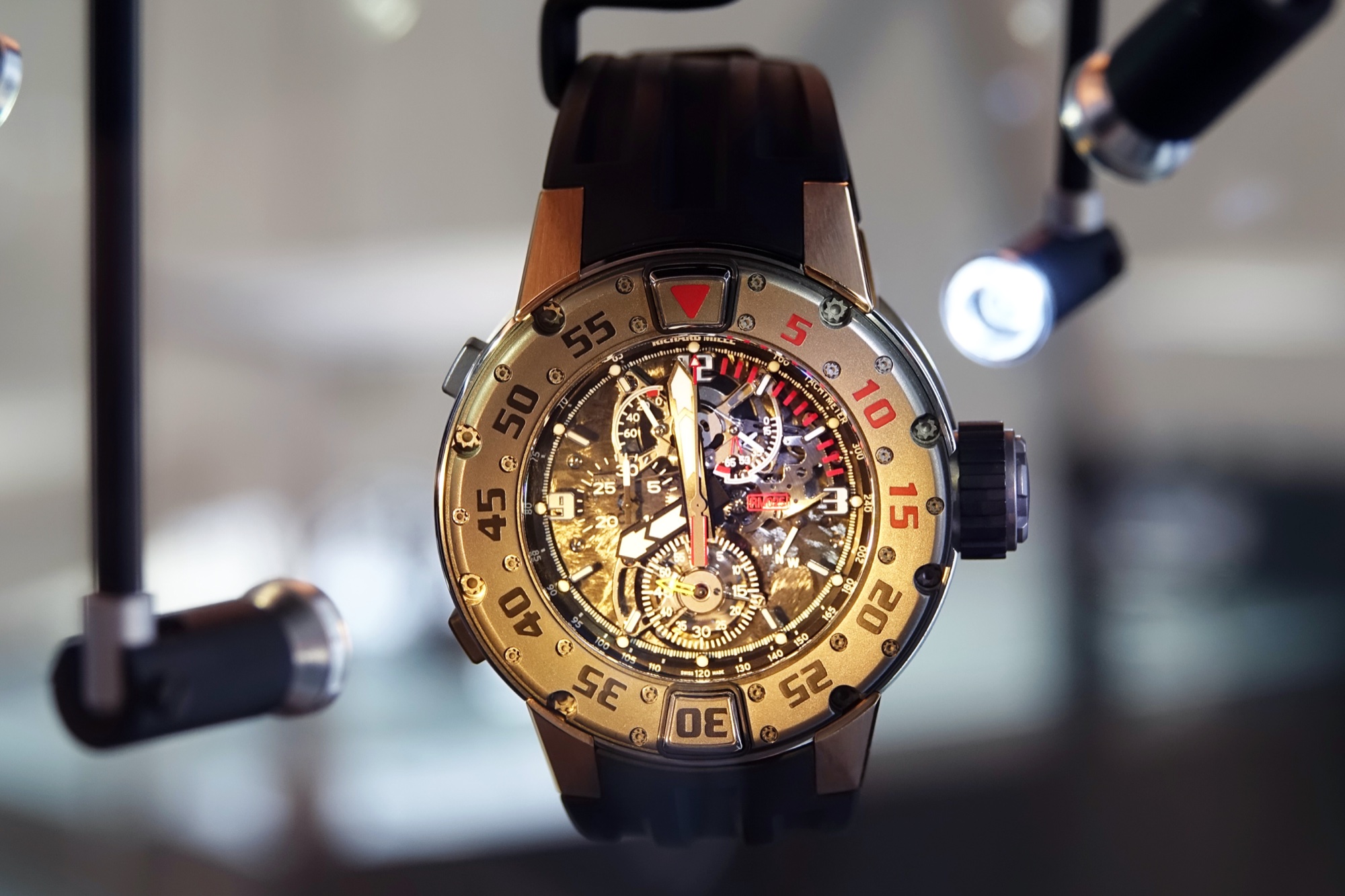
 via Wikimedia Commons, CC BY-SA 4.0
 What is Richard Mille?
Richard Mille is a Swiss luxury watch manufacturer founded 2001 by French luxury executive Richard Mille. Headquartered in Les Breuleux, Switzerland. Annual production: approximately 5,300 watches at an average price over $300,000 — the highest average price of any major Swiss watchmaker. Signature design is the tonneau-shaped case with openworked movement visible through the dial, often built from exotic composites (Carbon TPT, Quartz TPT, NTPT, sapphire). Many movements are co-developed with Audemars Piguet Renaud & Papi (APRP). The brand rebuilt haute horlogerie around athletes (Nadal, Massa, Bubba Watson) rather than heritage — a deliberate departure from the Swiss tradition.
History
Richard Mille (the man) spent the 1980s and 1990s in French luxury. He ran Mauboussin jewelry. He worked at the watch division of Aubert et Cie. By the late 1990s he had developed a thesis: Swiss haute horlogerie was selling itself short by tying its identity to centuries-old heritage when the actual market — the men who could afford tourbillons — wanted F1 cars, sport, and modern materials. He partnered with Dominique Guenat (a Vallée de Joux watchmaker) and presented the first watch in 2001.
The RM 001 was a manual-winding tourbillon in a tonneau case priced at SFr 135,000 — roughly the price of a Patek Philippe perpetual calendar at the time, from a brand that didn’t exist twelve months earlier. It sold out. The next watch, RM 002, added titanium baseplates. The RM 003 added a dual-time-zone display. By the mid-2000s, Richard Mille had the only growth curve in haute horlogerie that wasn’t inherited.
A watch should belong to the world of cars, planes, and aerospace, not the world of jewelry.
Richard Mille on positioning, 2008
The defining commercial breakthrough came with athletes. The RM 011 Felipe Massa (2007) — a flyback chronograph designed for an F1 driver — proved the watches would survive in competition. The RM 027 Rafael Nadal (2010) weighed 19 grams and was worn during Roland Garros matches. Bubba Watson’s RM 038 went around the PGA tour. Each athlete partnership doubled as engineering proof: the watches were not just expensive; they were genuinely shock-resistant in ways that traditional haute horlogerie wasn’t. The marketing strategy and the engineering brief were the same brief.
In 2022 Richard Mille released the RM UP-01 — 1.75mm thick, $1.88M retail, the world’s thinnest mechanical watch. The number was the news. The watch was a statement: 21 years after RM 001, the brand was still defining the upper boundary of what was technically possible. No legacy house has matched the trajectory.
Signature collections
RM 011
Released 2007 as the Felipe Massa edition. Flyback chronograph in a tonneau case with skeletonized movement. The RM 011 family is the broadest in the lineup — Carbon TPT, Quartz TPT, ceramic, gold, sapphire variants — and is the most-recognized RM silhouette. Modern RM 011 references retail $200,000–$500,000 depending on material and complication.
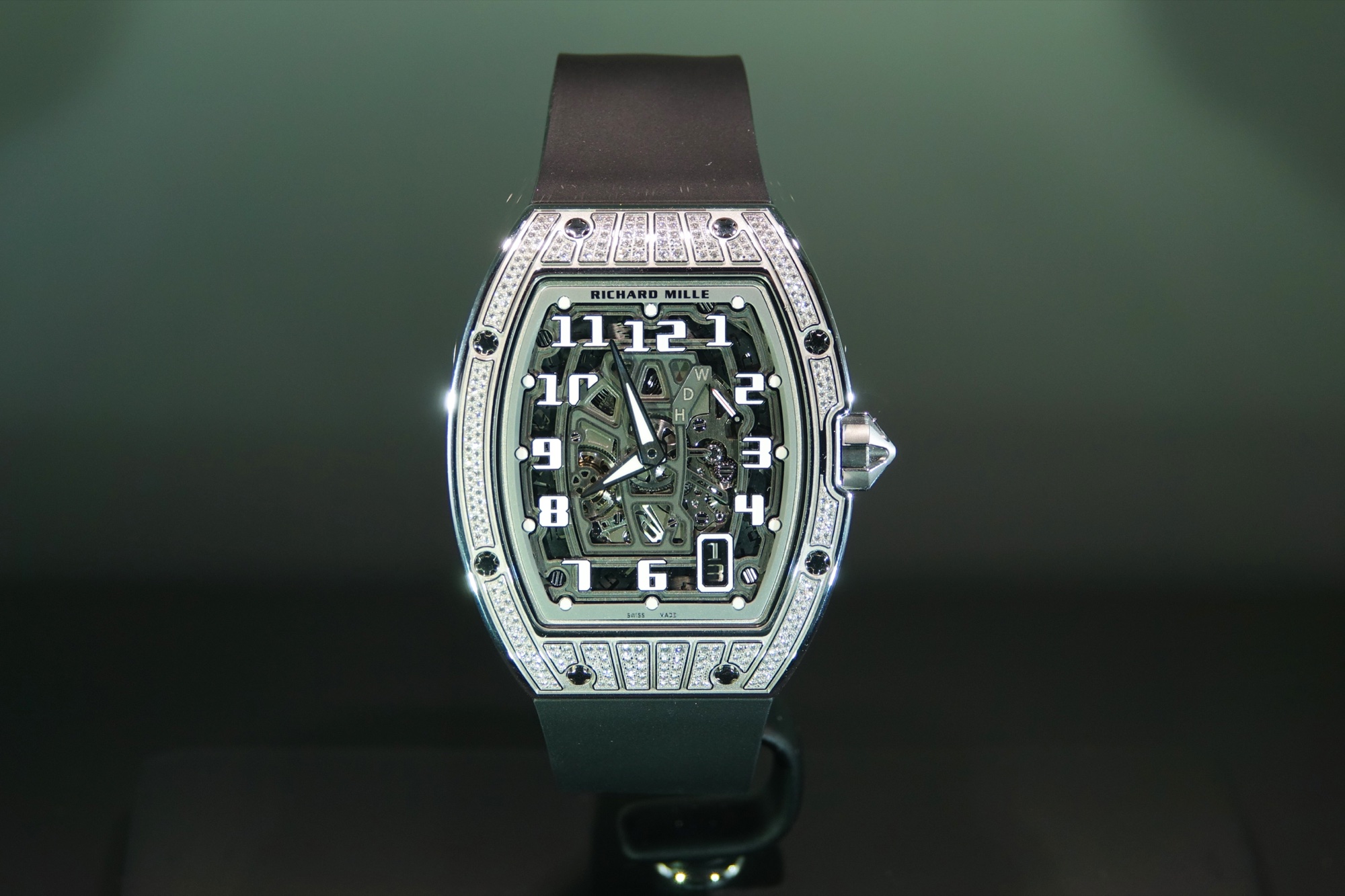
RM 027 / RM 35 / RM 67 (athletic)
The RM 027 (Rafael Nadal, 2010) was the first sub-20-gram tourbillon — a watch you could play tennis in. The RM 35 (Rafael Nadal, 2014) replaced it. The RM 67-01 Automatic Extra Plat (2016) is the slimmest entry in the modern lineup at 7.75mm thick with a skeletonized automatic movement. The athletic line proved the case engineering; the broader collection inherits the materials science.
RM 70 (motorsport)
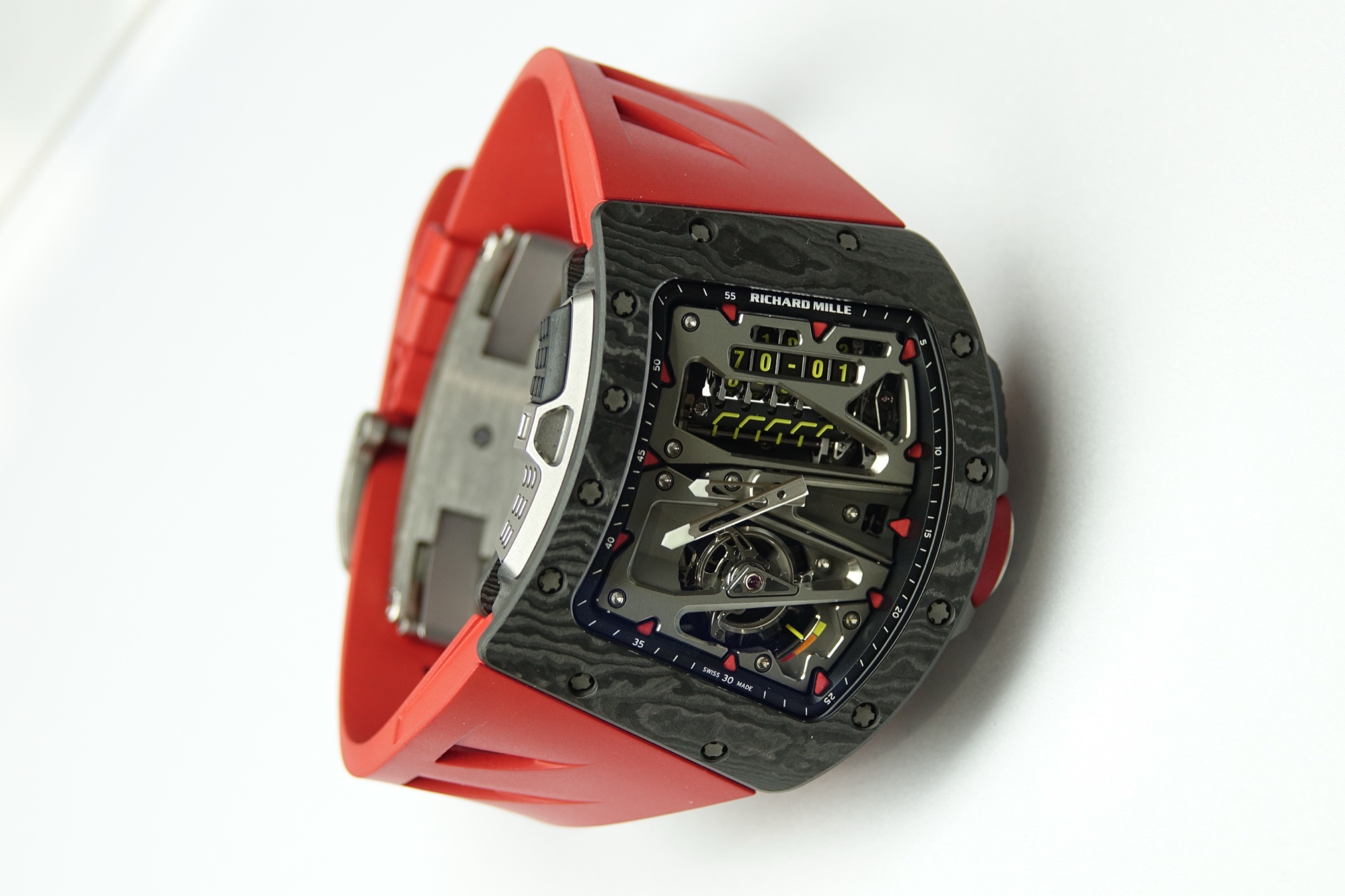
The RM 70-01 Tourbillon Alain Prost (2015) is the F1 watch — Carbon TPT case, red rubber strap, mileage counter on the dial that the wearer (Prost was an avid cyclist) advances by pressing pushers. The RM 50-03 Tourbillon McLaren F1 (2017) at 38 grams was the lightest mechanical chronograph ever produced. Motorsport collaborations are the lineage that ties the brand to its founding thesis — watches as performance equipment, not heritage objects.
RM UP-01 / sapphire / concept
The RM UP-01 (1.75mm thick, 2022) and the various sapphire-cased references sit at the technical and material flagship of the line. Sapphire RM 056 Tourbillon Split- Seconds Chronograph: roughly $2.5M retail. RM UP-01 Ferrari: $1.88M. These are the watches that define the upper edge of the brand and frequently set auction records.
Materials
The materials are part of the watch. Carbon TPT (Thin Ply Technology) is layers of carbon fiber compressed at varying angles — produces the visible swirl pattern that became an RM signature. Quartz TPT uses silica fiber at higher temperatures for more vivid color. NTPT (North Thin Ply Technology) is the carbon-composite supplier; the TPT variants come from their lab. Sapphire cases are machined from solid blocks of synthetic sapphire — production takes about 1,000 hours per case. Gold-titanium alloysand Carbon-NTPT-gold hybrids fill out the precious-metal end of the line. Steel is, deliberately, not in the catalog.
The materials are the watch. A Richard Mille without exotic composites would be an expensive tourbillon. With them, it’s a Richard Mille.
Price tiers
- Entry — RM 67-01 Automatic Extra Plat ($135,000–$200,000), RM 11-03 Flyback Chronograph (~$200,000)
- Mid — RM 011 Carbon TPT ($300,000–$500,000), RM 030 Automatic with Declutchable Rotor ($200,000+)
- Top — RM 70-01 Tourbillon Alain Prost ($800,000+), RM 56-02 Sapphire Tourbillon ($2.5M+), RM UP-01 Ferrari ($1.88M)
- Secondary market for popular references (RM 011 Massa, sapphire cases, RM 027 early Nadal) routinely 2–5× retail
What’s worth knowing
The APRP movement program is the technical anchor.Audemars Piguet Renaud & Papi — the high-complication arm of AP — co-develops many RM movements. That relationship is the reason the watches function at the level the price suggests. It also means many RM tourbillons share architectural DNA with AP tourbillons, just expressed through a different aesthetic vocabulary.
The brand is polarizing on purpose.Traditional Swiss horology culture frequently dismisses Richard Mille — too new, too loud, too expensive, not enough lineage. RM’s response has been consistent: the brand isn’t for traditional Swiss horology culture. It’s for people who buy supercars, who play professional tennis, who fly private. The market RM built has been more durable than its critics predicted.
Allocation is harder than Patek or AP.RM doesn’t do retail channel volume. New clients are typically introduced via an existing collector or brand partner. Boutique purchases require relationship-building. Most active demand is met on the secondary market, where most popular references trade at 2–4× retail.
Service is brand-only.Independent watchmakers cannot service Richard Mille watches. All service work runs through RM’s service centers (Geneva, Singapore, New York, Hong Kong). Service intervals are 4–7 years. Service costs run high — reasonable in proportion to the watch but unusually high in absolute terms ($5,000–$30,000+ depending on complication).