
Skip to content
Dive watch profile · Released 1967

Doxa SUB The Cousteau watch.

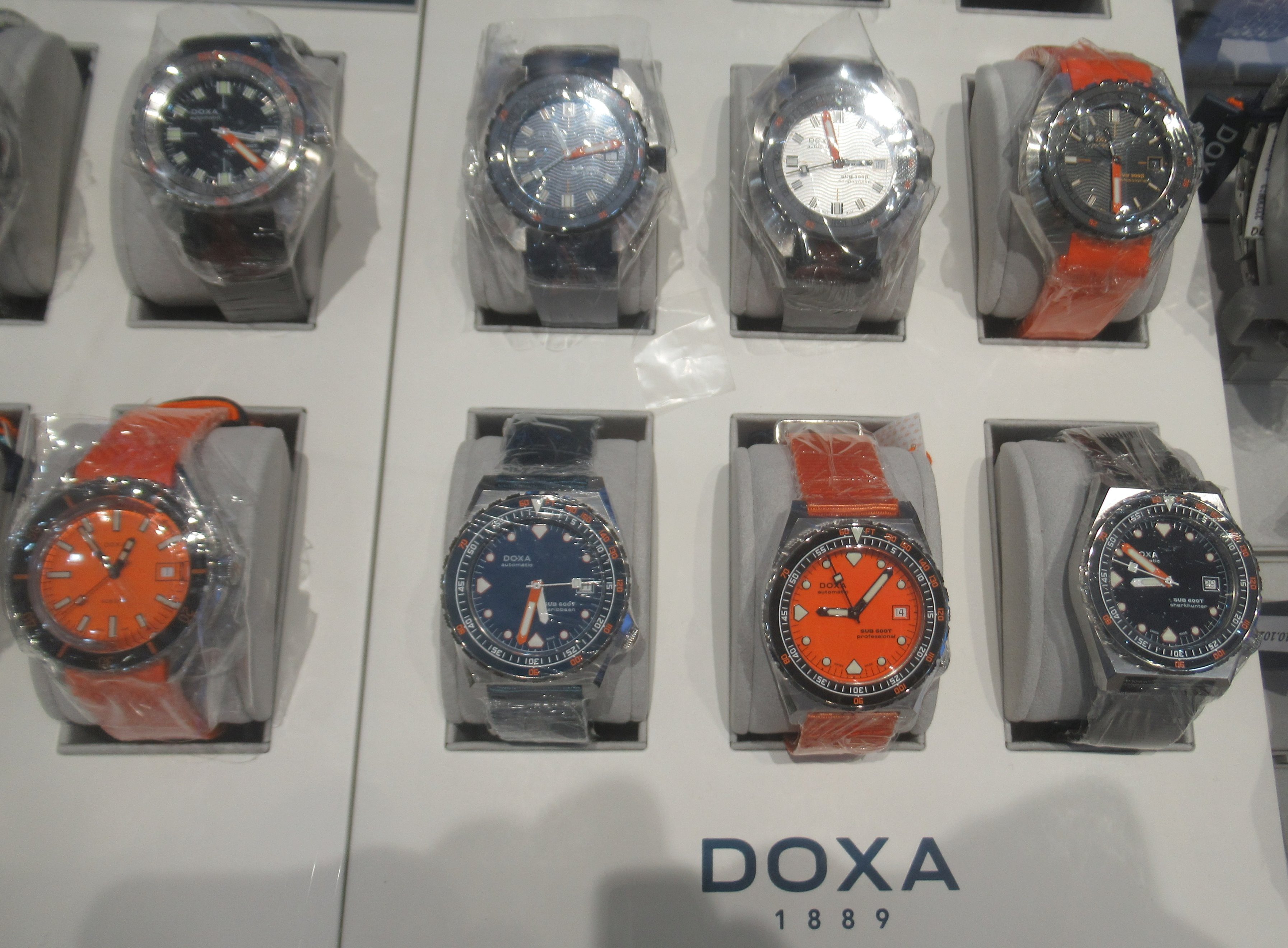
Orange dial from Le Locle. The dive bezel with US Navy no-decompression scale. Jacques Cousteau's personal watch and the cult favorite of professional divers.

Doxa SUB Professional orange dialVia Wikimedia Commons, CC BY-SA 4.0 (uploader uncredited) (source)

What is the Doxa SUB?

The Doxa SUB is a dive watch released 1967 by Doxa, a Swiss watchmaker founded 1889 in Le Locle. Best known for the orange "Professional" dial (specified for high underwater visibility in murky water) and the bezel with US Navy no-decompression-stop timing scale. Jacques Cousteau wore the Doxa SUB 300 throughout his ocean exploration career; his expedition company US Divers (Aqua-Lung) distributed the Doxa SUB in the United States starting 1968. Modern production: Doxa SUB 300T Professional ($1,990), SUB 600T Pacific ($2,290), SUB 200 ($990 quartz).

The Cousteau provenance

Jacques Cousteau wore the Doxa SUB 300 throughout his expedition years (late 1960s-1990s). Cousteau was personally involved in early discussions about the watch's specifications during 1966-1967 development, alongside Doxa engineer Urs Eschle. Cousteau's endorsement, plus the US Divers partnership (Cousteau's ocean expedition company that distributed Aqua-Lung diving equipment), made Doxa the unofficial watch of professional saturation diving in the late 1960s and 1970s.

The dive bezel

The Doxa SUB bezel features a unique no-decompression-stop scale — overlaying the standard 60-minute timing scale with US Navy dive table depth indicators. Each colored band on the bezel corresponds to a maximum no-decompression stay time at a given depth. A diver rotates the bezel to align the minute hand with the start of the dive, then reads elapsed time and remaining no-decompression time directly. The bezel is functional rather than decorative and was developed in collaboration with US Navy combat divers.

Modern collection

  • Doxa SUB 300T Professional ($1,990) — 42.5mm steel, orange dial, helium escape valve, ETA 2824-2 movement. The reference Doxa.
  • Doxa SUB 300T Searambler ($1,990) — silver dial variant.
  • Doxa SUB 300T Sharkhunter ($1,990) — black dial variant.
  • Doxa SUB 600T Pacific ($2,290) — 600m water resistance, larger case.
  • Doxa SUB 1500T Conquistador ($2,890) — 1,500m water resistance, the saturation-diving variant.
  • Doxa SUB 200 ($990) — quartz movement, full Doxa aesthetic at lower price point.
  • Doxa SUB 300 Carbon ($2,890) — carbon composite case, lighter modern variant.

Why Doxa is collected

Doxa occupies a specific position in modern dive-watch culture: cult favorite of professional and saturation divers, distinct visual signature (orange dial), historical provenance (Cousteau, US Divers, US Navy), and pricing meaningfully below Submariner/Seamaster equivalents. For buyers who want a dive watch with serious historical pedigree at $2,000-$3,000, Doxa is the most-defensible answer. The brand is smaller than the Swiss giants but has retained its dive-watch identity throughout its modern existence.

Read next

Frequently Asked

On the Doxa SUB

Why does Cousteau's name come up with Doxa?

Jacques Cousteau wore the Doxa SUB 300 (released 1967) extensively during his ocean exploration work. Cousteau's ocean expedition company US Divers (Aqua-Lung) distributed the Doxa SUB in the United States starting in 1968 — Doxa was the only watch the company endorsed for diving. Cousteau's Doxa is on display at the Doxa museum in Le Locle. The orange dial, originally specified by Doxa for high underwater visibility, became Doxa's signature aesthetic.

What is the Doxa orange dial called?

The orange-dial Doxa is called the "Professional" — the original 1967 reference. Doxa's color taxonomy: Professional (orange), Searambler (silver), Sharkhunter (black), Caribbean (blue), Aquamarine (turquoise blue). The Professional orange is the most iconic and was specified for high visibility in murky tropical water.

What is unique about the Doxa bezel?

The Doxa SUB bezel features a no-decompression-stop scale based on US Navy dive tables — overlaying the standard timing scale with depth indicators showing the maximum no-decompression stay time at various depths. A diver can rotate the bezel to align the minute hand with the start of the dive, then read both elapsed time and the depth-time limit directly. The scale is functional rather than decorative and was developed in collaboration with US Navy divers in 1967.

Is Doxa Swiss-made?

Yes — Doxa is headquartered in Le Locle, Switzerland, where it has operated since 1889. The brand was founded by Georges Ducommun and has remained Swiss-made throughout its history. Doxa was acquired by the Jenny family in 1980 and then by current owners (a Swiss-based investment group) in 2002. Production continues in Le Locle.

Which Doxa SUB should I buy?

Doxa SUB 300T Professional ($1,990) — orange dial, the canonical Doxa, 42.5mm. Doxa SUB 300 Professional Carbon ($2,890) — carbon-composite case, lighter and more modern. Doxa SUB 600T Pacific ($2,290) — 600m water resistance, helium escape valve. Doxa SUB 200 ($990) — entry-level Doxa with quartz movement, full Doxa aesthetic at a third the price of mechanical references.

What is The Essential Watch Guide?

The Essential Watch Guide is an editorial publication covering luxury watchmaking — Swiss heritage houses, dive watches, vintage timepieces, and the makers worth knowing. Coverage includes Rolex, Patek Philippe, Audemars Piguet, Vacheron Constantin, Omega, Tudor, and dozens more. Editorial focus: history, signature collections, what to look for when buying, and how value holds.

Which Swiss watch brands are the most prestigious?

The "Holy Trinity" of Swiss watchmaking is Patek Philippe (founded 1839), Audemars Piguet (1875), and Vacheron Constantin (1755) — the three houses widely considered the apex of haute horlogerie. Rolex is the most recognized worldwide; Jaeger-LeCoultre supplies movements to many top brands; Blancpain is the oldest continuously operating watchmaker (founded 1735). Independent makers like F.P. Journe and Richard Mille operate at the same tier with smaller production runs.

What makes a watch "Swiss made"?

Swiss law requires that a watch labeled "Swiss made" must have its movement assembled in Switzerland, its movement cased in Switzerland, undergone final inspection by the manufacturer in Switzerland, and have at least 60% of its production cost incurred in Switzerland. The standard is enforced by the Federal Council and the Federation of the Swiss Watch Industry FH.