Skip to content
Maker profile · Geneva · Founded 1755

Vacheron Constantin The oldest continuously operating manufacturer.

9 min readPublished

The Holy Trinity's quietest member. Two-hundred-seventy years of continuous production. The 57-complication Reference 57260 holds the record few people will ever match.

Vacheron Constantin Patrimony dial close-upCharles J. Sharp, CC BY-SA 4.0, via Wikimedia Commons (source)

What is Vacheron Constantin?

Vacheron Constantin is a Swiss luxury watch manufacturer founded 1755 in Geneva — the oldest continuously operating watch manufacturer in the world. Annual production: roughly 20,000 watches, the smallest of the Holy Trinity, made in Plan-les-Ouates (Geneva) and the Vallée de Joux. The house created the first watch complication in 1790 and produced Reference 57260 — the world's most complicated mechanical watch with 57 horological complications, completed in 2015 after eight years of development. Acquired by the Richemont Group in 1996. The Maltese cross has been the brand signature since 1880.

History

Jean-Marc Vacheron — a 24-year-old watchmaker — registered his first apprentice contract in Geneva on 17 September 1755. That document, preserved in the Vacheron archives, is the earliest written record of the company's existence. Vacheron built movements in the émergent "Cabinotier" tradition — Geneva's upper-floor workshops where master watchmakers practiced the craft.

In 1819, Jacques-Barthélémi Vacheron (Jean-Marc's grandson) partnered with François Constantin, a businessman who had previously sold Vacheron movements across Europe. The partnership became Vacheron Constantin. Constantin's 1819 letter to Jacques-Barthélémi contained the line that became the corporate motto: Faire mieux si possible, ce qui est toujours possible— "Do better if possible, and that is always possible." The phrase has stayed on every internal communication and external document for over two centuries.

Tradition is the working method, not the marketing slogan. Vacheron has signed every watch in Geneva for 270 years.

Vacheron's 'Hallmark of Geneva' standard

Technical milestones across the next 200 years:

  • 1790 — First watch complication
  • 1839 — First lever escapement created by Georges-Auguste Leschot
  • 1844 — First Maltese cross-shaped balance
  • 1880 — Maltese cross adopted as the brand symbol
  • 1928 — First mid-20th-century Tour de l'Île pocket watch — predecessor of the modern reference
  • 1955 — Reference 6087, "Cioccolatone" — among the first wristwatches with a triple calendar
  • 1996 — Acquired by Vendome Group (later Richemont)
  • 2004 — 250th anniversary; Tour de l'Île released — at the time the most complicated wristwatch in the world (16 complications)
  • 2015 — Reference 57260 — the world's most complicated mechanical watch (57 complications)

The Plan-les-Ouates manufacture, designed by Bernard Tschumi and inaugurated in 2005, is one of the most architecturally significant watchmaking facilities in Switzerland — a steel-and-glass structure that consciously echoes the Maltese cross in plan view. The historical workshop in the Vallée de Joux remains in operation for hand-finishing and Métiers d'Art production.

Signature collections

Patrimony

The pure-dress-watch collection. The Patrimony Self-Winding 4100U/110A ($24,500 in steel) is the entry — 39.5mm, two-hand, in-house Caliber 2450 Q6 with 22K gold rotor, alligator strap. The Patrimony Manual-Winding 1110U ($21,500) and the Patrimony Perpetual Calendar 43175 ($104,500) extend the line. The dial language is the cleanest in Geneva — minute track, applied hour markers, baton hands. No ornamentation that doesn't earn its place.
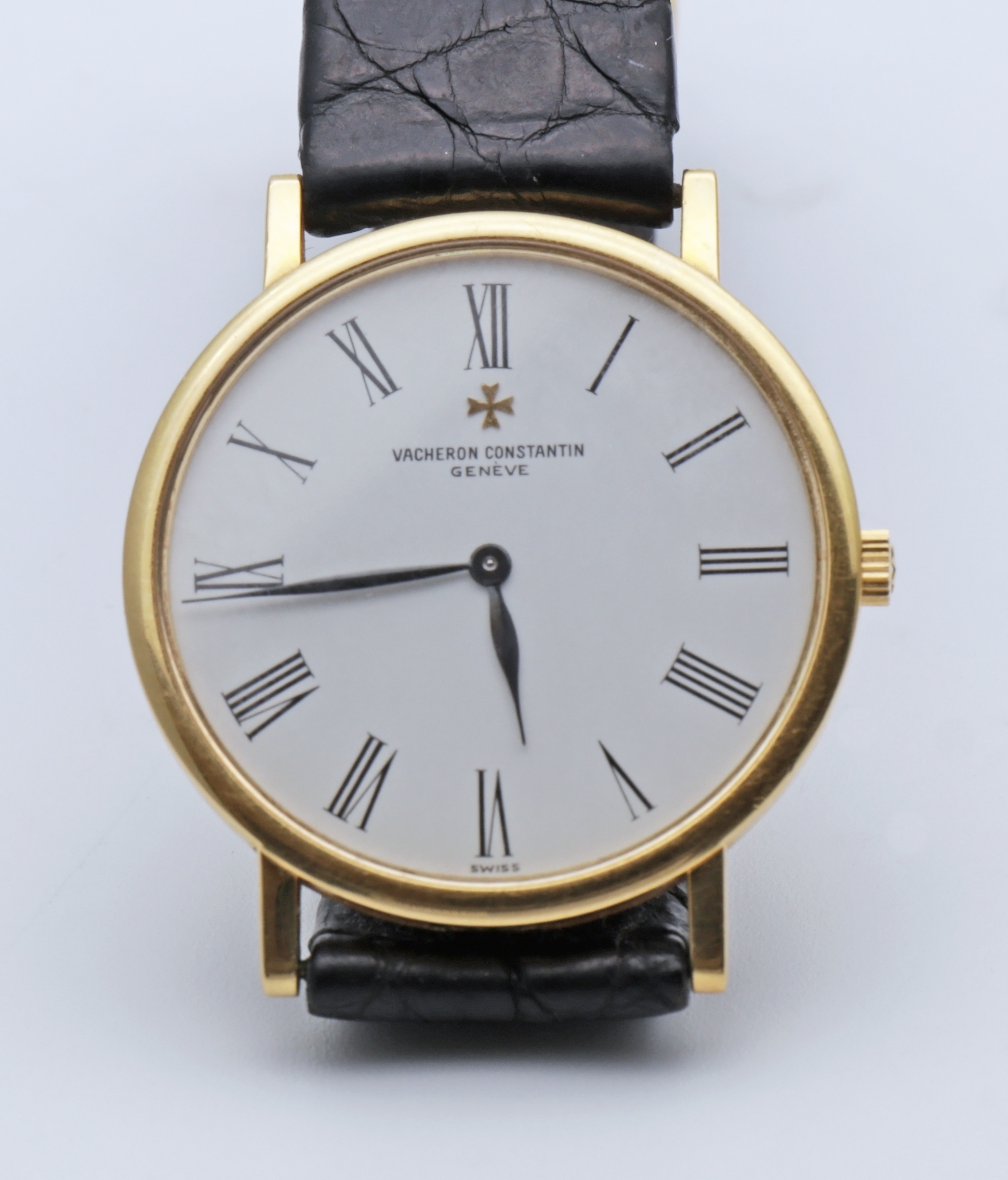
Vacheron Constantin — Patrimony
Charles J. Sharp, CC BY-SA 4.0, via Wikimedia Commons (source)

Overseas

The integrated-bracelet sport collection. Released 1996, redesigned 2016. The Overseas Self-Winding 4520V ($26,500 in steel) ships with three interchangeable strap options (steel bracelet, leather, rubber) and quick-release lugs. The in-house Caliber 5100 was developed specifically for the line. The Maltese cross motif appears in the bezel form. Overseas Chronograph 5500V ($35,500), Overseas Dual Time 7900V ($30,000), and Overseas Perpetual Calendar 4300V ($98,500) extend the collection. The most direct competitor to the Royal Oak and Nautilus.

Métiers d'Art

Hand-decorative pieces. Cloisonné enamel dials, miniature painting, engraving, guilloché. Series tied to artistic themes — Métiers d'Art Les Masques (2007, tribal masks), Métiers d'Art La Symbolique des Laques (2010), Métiers d'Art Copernicus Celestial Spheres 2460 RT (2017). Each piece in a series produced in a limited run; many sold only to long-standing clients. Often $80,000 to $300,000+.

Traditionnelle

Classical round dress watches with stylistic links to the brand's 19th-century pocket-watch heritage — fluted bezel option, cabochon crown on some references, Roman numerals. The Traditionnelle Manual Winding ($23,500 in steel) is the entry; the Traditionnelle Tourbillon ($143,000) and Traditionnelle Twin Beat Perpetual Calendar ($199,500) sit at the technical end.
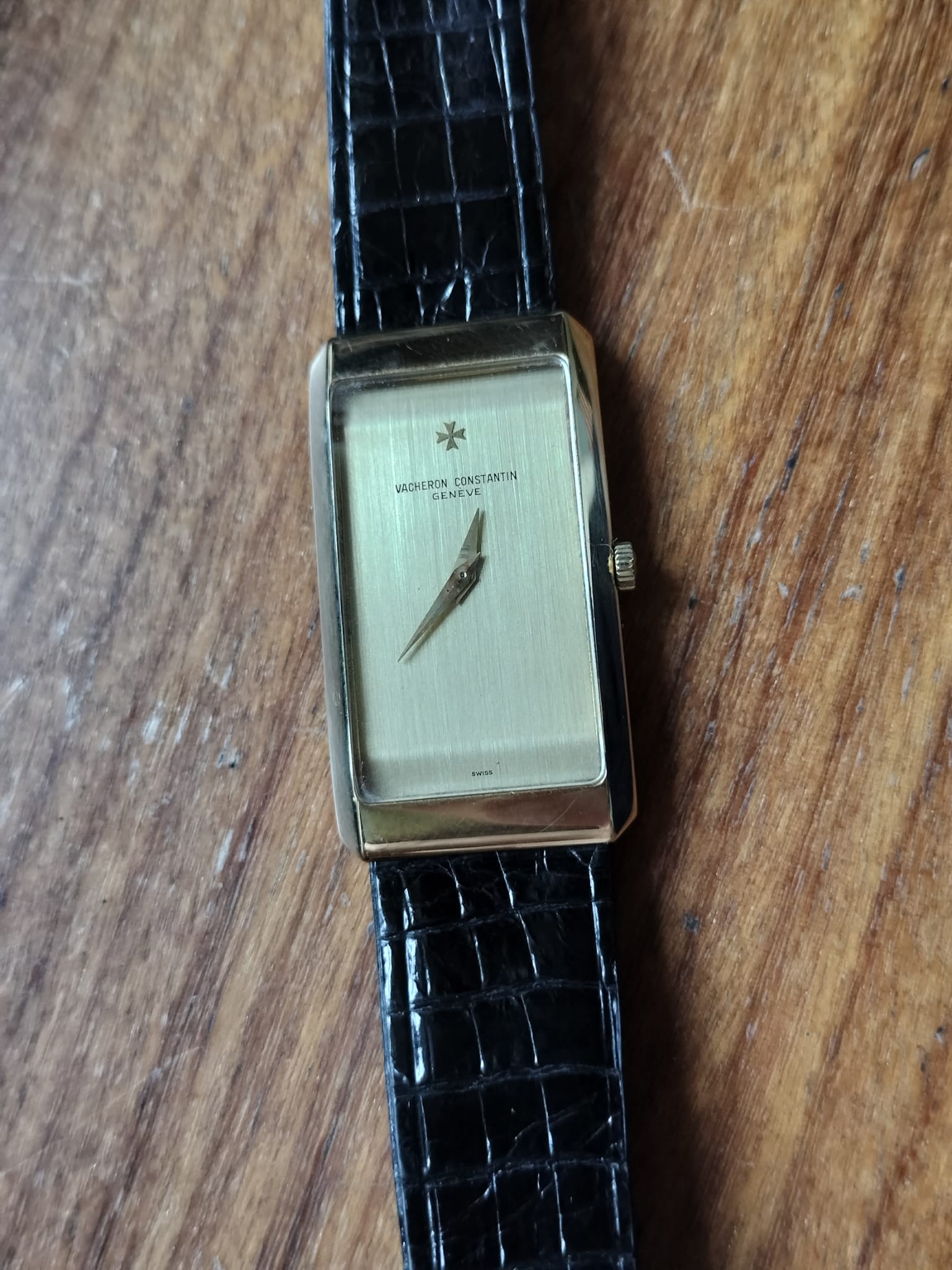
Vacheron Constantin — Vacheron Constantin dress watch (Traditionnelle-style)
Clyde94, CC BY-SA 4.0, via Wikimedia Commons (source)

Historiques

Reissues of historical references — the Historiques American 1921 (a driver's watch with the dial rotated 45° for steering-wheel legibility), the Historiques Triple Calendrier 1942/1948, and the Historiques Cornes de Vache 1955. Smaller productions, often in precious metals, with movement architecture true to the originals.

Reference 57260 (one-off)

The world's most complicated mechanical watch. 57 horological complications. Eight years of development by three master watchmakers — Yannick Pintus, Jean-Luc Perrin, Michel Suchet. Completed 2015 for the brand's 260th anniversary. Commissioned by a private collector. Includes complications no other watch has — perpetual Hebrew calendar, sky chart customized to the owner's coordinates, multiple chime modes including the Westminster carillon. Not for sale; the piece was made to a specification.

Fifty-seven complications. Eight years. One watch. Reference 57260 is what happens when a 270-year-old house decides to build for itself.

Price tiers

  • Entry — Patrimony Manual-Winding ($21,500), Patrimony Self-Winding ($24,500), Overseas Small Model ($25,500)
  • Mid — Overseas Self-Winding ($26,500), Traditionnelle Manual ($23,500), Patrimony Day-Date ($30,000)
  • Sport flagship — Overseas Chronograph ($35,500), Overseas Dual Time ($30,000), Overseas Perpetual Calendar ($98,500)
  • Grand Complications — Patrimony Perpetual Calendar ($104,500), Traditionnelle Tourbillon ($143,000), Traditionnelle Twin Beat Perpetual Calendar ($199,500), Métiers d'Art ($80K-$300K+)
  • Collector / commissioned — Tour de l'Île, Reference 57260 (one-off), historical pocket watches at auction. Often six to seven figures.

What's worth knowing

Vacheron is the maker that other watchmakers respect. The brand operates without the auction theatrics of Patek or the celebrity pulse of AP. Among watch collectors, Vacheron is often considered the equal of Patek — and in finishing of certain calibers, sometimes superior. Among the general public, the brand is the quietest of the Trinity.

The Maltese cross logo references the shape of the wheel-stop component used in early Vacheron movements — a pawl-and-ratchet system that prevents over-winding. The shape was adopted as a brand symbol in 1880. It now appears on dials, crowns, bracelets, and as decorative motifs throughout the catalog. The shape is the brand's most recognizable signature short of script.

Most Vacheron movements meet or exceed the Geneva Seal — the 226-year-old quality certification that requires hand-finished bridges, polished steelwork, jeweled pivots, and aesthetic standards across 12 specific criteria. Some Métiers d'Art pieces also receive the Hallmark of Geneva. Movement finishing on Patrimony and Traditionnelle pieces is among the cleanest in commercial Swiss watchmaking.

Read more

For the rest of the Trinity:

For the Richemont Group sister brand at lower price points:

For the broader survey:

Frequently Asked

On Vacheron Constantin

What is the world's most complicated mechanical watch?

The Vacheron Constantin Reference 57260 is the world's most complicated mechanical watch — 57 horological complications including a perpetual Hebrew calendar, multiple chime modes, sky chart with custom-mapped constellations, and a sunrise/sunset indicator. The piece took eight years of development by three master watchmakers (Yannick Pintus, Jean-Luc Perrin, Michel Suchet) and was completed in 2015 to mark Vacheron's 260th anniversary. It is a unique piece commissioned by a private collector.

How many Vacheron Constantin watches are made each year?

Vacheron Constantin produces approximately 20,000 watches per year — the smallest production of the Holy Trinity. Production is split between the Plan-les-Ouates manufacture in Geneva (architecturally significant, designed by Bernard Tschumi) and the historical Vallée de Joux atelier. Most production is hand-finished to Geneva Seal or higher standards.

Why is Vacheron Constantin less famous than Patek Philippe?

Marketing posture and family ownership. Vacheron has been part of the Richemont Group since 1996 — operating within a luxury conglomerate rather than as an independent family business like Patek. Vacheron also markets less aggressively. The brand's positioning is internal to the watch community: Vacheron is the maker that other watchmakers respect for technical depth and finishing, while remaining quieter in the broader cultural conversation. Among collectors, Vacheron is often considered the equal of Patek; among the general public, Patek is more recognized.

What is the Vacheron Constantin motto?

The Vacheron motto is "Faire mieux si possible, ce qui est toujours possible" — "Do better if possible, and that is always possible." It was first used by François Constantin in a letter dated 5 July 1819 and has remained the brand's guiding principle for over 200 years. The phrase appears on internal communications, training materials, and the brand's anniversary publications.

Which Vacheron Constantin is the best entry?

The Patrimony Self-Winding 4100U/110A in steel ($24,500) is the canonical entry — a 39.5mm two-hand dress watch with the in-house Caliber 2450 Q6 and the cleanest Vacheron dial language. The Overseas Self-Winding 4520V ($26,500 in steel) is the sport entry — integrated bracelet, three interchangeable strap options, in-house Caliber 5100. Both sit in the $24K-$28K range that defines first-Vacheron territory and offer the easiest allocation among the Trinity makers.

When was Vacheron Constantin founded and by whom?

Jean-Marc Vacheron founded the company in 1755 in Geneva, making it the oldest continuously operating watch manufacturer in the world. François Constantin joined in 1819, giving the company its current name. The Maltese cross logo dates from 1880. The company was family-owned until 1987, when it was acquired by Yemenchi (an investment group), then sold to Vendome (later Richemont) in 1996. The company is currently part of the Richemont Group alongside Cartier, IWC, JLC, Panerai, Piaget, and others.

What is Vacheron Constantin?

Vacheron Constantin is a Swiss luxury watch manufacturer founded 1755 in Geneva — the oldest continuously operating watch manufacturer in the world. Annual production: approximately 20,000 watches, made in Plan-les-Ouates (Geneva) and the Vallée de Joux. The house created the first watch complication in 1790 and produced Reference 57260 (2015), the world's most complicated mechanical watch with 57 complications. Vacheron sits in the "Holy Trinity" of haute horlogerie alongside Patek Philippe and Audemars Piguet. Acquired by the Richemont Group in 1996. Pocket watch No. 402833, once owned by King Fuad I of Egypt, sold for $2.77 million at auction in 2005.

What is the world's most complicated mechanical watch?

The Vacheron Constantin Reference 57260 is the world's most complicated mechanical watch — 57 horological complications including a perpetual Hebrew calendar, multiple chime modes, sky chart with custom-mapped constellations, and a sunrise/sunset indicator. The piece took eight years of development by three master watchmakers (Yannick Pintus, Jean-Luc Perrin, Michel Suchet) and was completed in 2015 to mark Vacheron's 260th anniversary. It is a unique piece commissioned by a private collector.

How many Vacheron Constantin watches are made each year?

Vacheron Constantin produces approximately 20,000 watches per year — the smallest production of the Holy Trinity. Production is split between the Plan-les-Ouates manufacture in Geneva (architecturally significant, designed by Bernard Tschumi) and the historical Vallée de Joux atelier. Most production is hand-finished to Geneva Seal or higher standards.

Why is Vacheron Constantin less famous than Patek Philippe?

Marketing posture and family ownership. Vacheron has been part of the Richemont Group since 1996 — operating within a luxury conglomerate rather than as an independent family business like Patek. Vacheron also markets less aggressively. The brand's positioning is internal to the watch community: Vacheron is the maker that other watchmakers respect for technical depth and finishing, while remaining quieter in the broader cultural conversation. Among collectors, Vacheron is often considered the equal of Patek; among the general public, Patek is more recognized.

What is the Vacheron Constantin motto?

The Vacheron motto is "Faire mieux si possible, ce qui est toujours possible" — "Do better if possible, and that is always possible." It was first used by François Constantin in a letter dated 5 July 1819 and has remained the brand's guiding principle for over 200 years. The phrase appears on internal communications, training materials, and the brand's anniversary publications.

Which Vacheron Constantin is the best entry?

The Patrimony Self-Winding 4100U/110A in steel ($24,500) is the canonical entry — a 39.5mm two-hand dress watch with the in-house Caliber 2450 Q6 and the cleanest Vacheron dial language. The Overseas Self-Winding 4520V ($26,500 in steel) is the sport entry — integrated bracelet, three interchangeable strap options, in-house Caliber 5100. Both sit in the $24K-$28K range that defines first-Vacheron territory and offer the easiest allocation among the Trinity makers.

When was Vacheron Constantin founded and by whom?

Jean-Marc Vacheron founded the company in 1755 in Geneva, making it the oldest continuously operating watch manufacturer in the world. François Constantin joined in 1819, giving the company its current name. The Maltese cross logo dates from 1880. The company was family-owned until 1987, when it was acquired by Yemenchi (an investment group), then sold to Vendome (later Richemont) in 1996. The company is currently part of the Richemont Group alongside Cartier, IWC, JLC, Panerai, Piaget, and others.

What is The Essential Watch Guide?

The Essential Watch Guide is an editorial publication covering luxury watchmaking — Swiss heritage houses, dive watches, vintage timepieces, and the makers worth knowing. Coverage includes Rolex, Patek Philippe, Audemars Piguet, Vacheron Constantin, Omega, Tudor, and dozens more. Editorial focus: history, signature collections, what to look for when buying, and how value holds.

Which Swiss watch brands are the most prestigious?

The "Holy Trinity" of Swiss watchmaking is Patek Philippe (founded 1839), Audemars Piguet (1875), and Vacheron Constantin (1755) — the three houses widely considered the apex of haute horlogerie. Rolex is the most recognized worldwide; Jaeger-LeCoultre supplies movements to many top brands; Blancpain is the oldest continuously operating watchmaker (founded 1735). Independent makers like F.P. Journe and Richard Mille operate at the same tier with smaller production runs.

What makes a watch "Swiss made"?

Swiss law requires that a watch labeled "Swiss made" must have its movement assembled in Switzerland, its movement cased in Switzerland, undergone final inspection by the manufacturer in Switzerland, and have at least 60% of its production cost incurred in Switzerland. The standard is enforced by the Federal Council and the Federation of the Swiss Watch Industry FH.