
Skip to content
Maker profile · Le Sentier · Founded 1833

Jaeger-LeCoultre Movements for the Trinity.

9 min readPublished

The watchmaker's watchmaker. Over 1,000 calibers in the archive. The Reverso has been in continuous production for 95 years.

Jaeger-LeCoultre Reverso flippedRemi Mathis, CC BY-SA 4.0, via Wikimedia Commons (source)

What is Jaeger-LeCoultre?

Jaeger-LeCoultre is a Swiss luxury watchmaker founded 1833 in Le Sentier, Vallée de Joux. Annual production: 50,000-70,000 watches. Holds over 100 patents and has produced more than 1,000 distinct calibers — more than any other Swiss manufacturer. Historically known as "the watchmaker's watchmaker" because the house has supplied movements to Patek Philippe, Audemars Piguet, Vacheron Constantin, IWC, and Cartier. Famous for the Atmos clock (1928), the Reverso (1931), and the Hybris Mechanica Grande Sonnerie. Part of the Richemont Group since 2000.

History

Antoine LeCoultre, an inventor and watchmaker, opened a workshop in 1833 in Le Sentier — a village in the Vallée de Joux that had become Switzerland's technical heart of haute horlogerie. LeCoultre's first major invention came in 1844: the Millionomètre, a measurement instrument that could read distances down to one micron. Until that point, no instrument existed that could measure watch components with sufficient precision. The Millionomètre allowed LeCoultre to produce parts to tolerances no other manufacturer could achieve.

A watchmaker who can't build his own movement is a watch dealer.

Antoine LeCoultre's workshop log, 1844

By the late 19th century, LeCoultre & Cie. had become the largest manufacturer of watch movements in the Vallée de Joux — supplying calibers to Patek Philippe, Cartier, and dozens of other brands across Europe. The relationship with Edmond Jaeger of Paris began in 1903; Jaeger had been Cartier's watchmaker and brought a Paris-side commercial network. The two companies merged in 1937 under the Jaeger-LeCoultre name.

The technical record is unparalleled in volume:

  • 1844 — Millionomètre (one-micron precision instrument)
  • 1903 — First successful spring-driven alarm wristwatch movement
  • 1928 — Atmos clock (atmospheric-pressure-powered)
  • 1929 — Caliber 101, the smallest mechanical movement ever made (still in production for ladies' jewelry watches)
  • 1931 — Reverso (flippable rectangular case, designed for polo)
  • 1953 — Futurematic (the first wristwatch with a power reserve indicator and no crown)
  • 1958 — Geophysic (a rugged anti-magnetic watch for the International Geophysical Year)
  • 1967 — Caliber 920 (used in the original Patek Nautilus, AP Royal Oak, and Vacheron 222)
  • 1992 — Reverso Duoface (two dials, two time zones, one movement)
  • 2009 — Hybris Mechanica à Grande Sonnerie (one of the most complicated wristwatches ever made)

Signature collections

Reverso

The most iconic JLC. Released 1931 to solve a polo problem — British Army officers in India needed wristwatches that could survive mallet strikes. César de Trey commissioned a flippable case design from JLC; the resulting Reverso has stayed in production essentially unchanged for 95 years. Modern Reverso Classic Medium Thin ($9,750), Reverso Tribute Duoface ($14,300), and Reverso Tribute Nonantième ($114,000, the 90th anniversary) anchor the line. Reverso Hybris Mechanica complicated pieces reach six figures.

The Reverso flips because Indian polo players in 1931 needed a watch that could survive a chukka. Eighty years later it's still the only watch that flips.
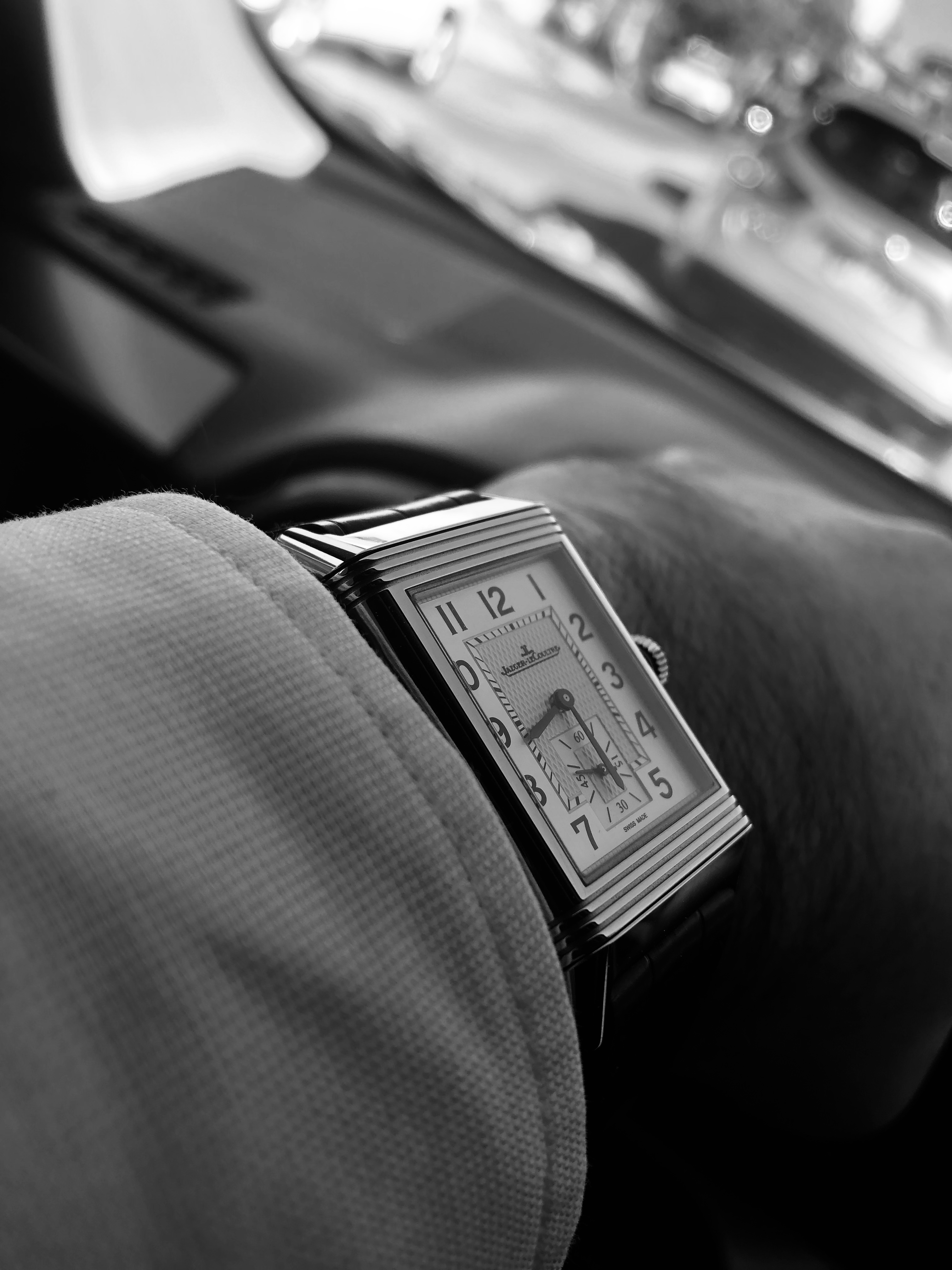
Jaeger-LeCoultre — Reverso Classic
Tiberido, CC BY-SA 4.0, via Wikimedia Commons (source)

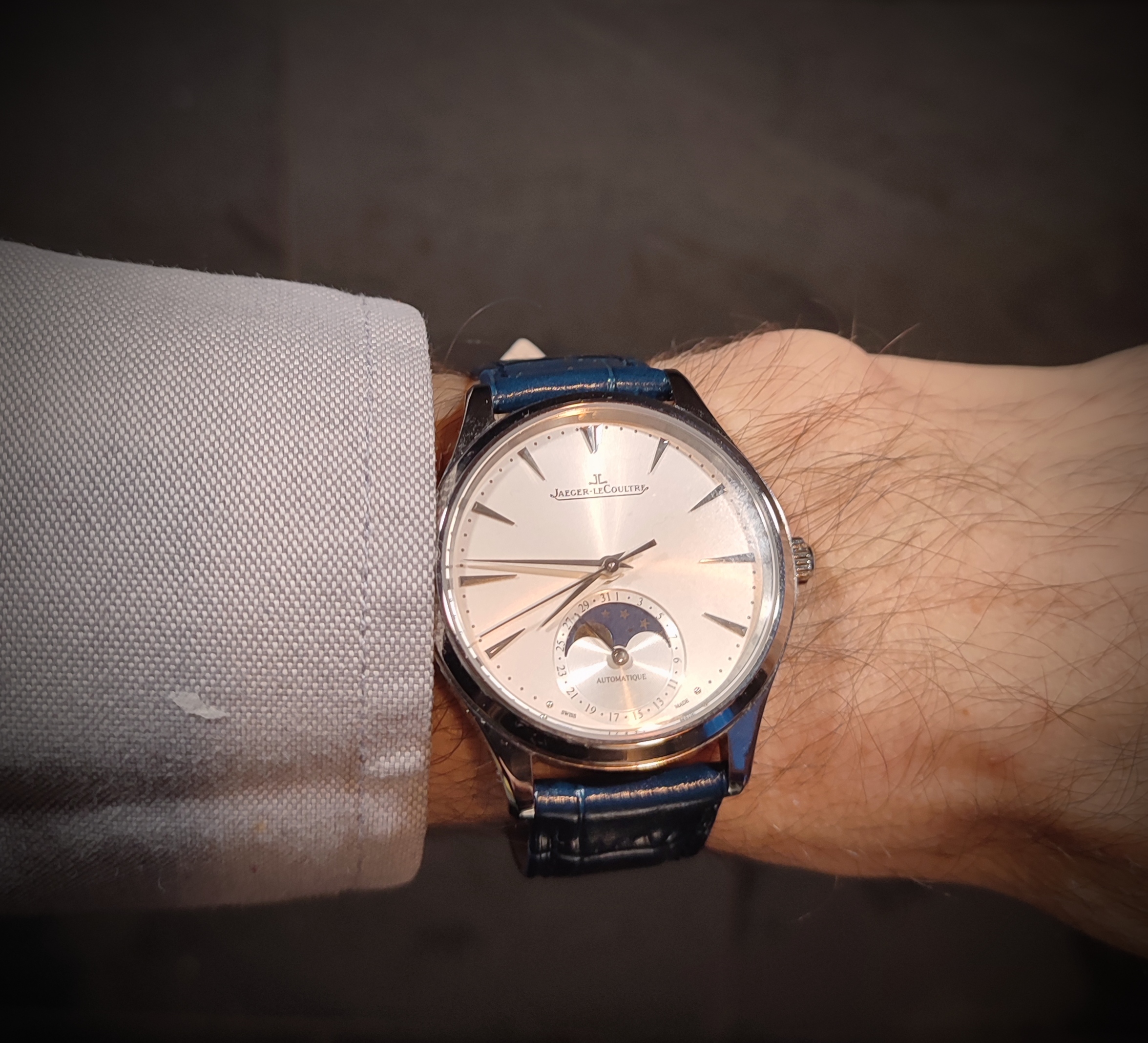
Master Ultra Thin

The dress watch family. Master Ultra Thin Moon ($14,800), Master Ultra Thin Date ($10,800), Master Ultra Thin Small Seconds ($9,300). 39mm cases, in-house Caliber 925 family, classic dial language. The Master Ultra Thin Squelette ($46,700) is one of the cleanest skeletonized dress watches in the catalog.
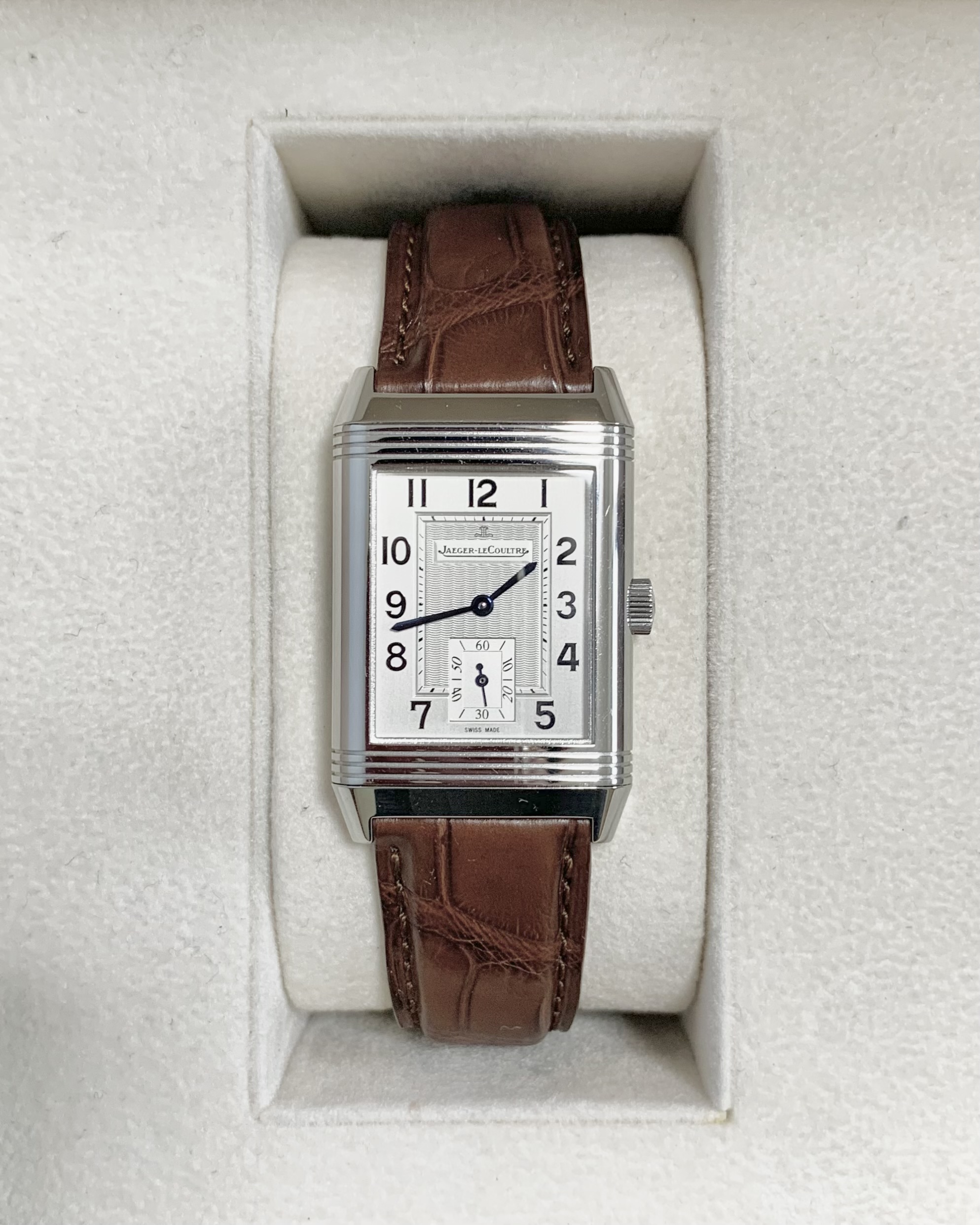
Jaeger-LeCoultre — Reverso (2011, Tribute-style)
Provo rossi, CC BY 4.0, via Wikimedia Commons (source)

Polaris

The modern sport collection — released 2018 as JLC's response to the integrated-bracelet sport luxury wave. Polaris Date ($10,300 in steel), Polaris Geographic ($16,500), Polaris Chronograph ($14,500). Round case (not octagonal), inner rotating bezel, sport-watch heritage from the 1968 Memovox Polaris dive watch.

Atmos

The pressure-powered clock. Limited editions designed by Marc Newson, Hermès, and others. New Atmos prices range from $9,000-$50,000 for standard production; collaboration pieces go higher. The Atmos can theoretically run for centuries without intervention.

Duomètre, Hybris Mechanica

The technical-flagship lines. Duomètre pieces feature the Dual-Wing concept — two independent power trains for chronograph and timekeeping (avoiding the "chronograph drag" problem). Hybris Mechanica pieces include the world's most complicated wristwatch, the Hybris Mechanica 11 ($2.5M+).

Price tiers

  • Entry — Reverso Classic Medium Thin ($9,750), Master Ultra Thin Small Seconds ($9,300), Polaris Date ($10,300)
  • Mid — Master Ultra Thin Date ($10,800), Master Ultra Thin Moon ($14,800), Reverso Tribute Duoface ($14,300), Polaris Chronograph ($14,500)
  • Flagship — Master Ultra Thin Squelette ($46,700), Master Grande Tradition Tourbillon ($85,000), Duomètre Chronograph ($63,000)
  • Hybris Mechanica — Six and seven figures
  • Collector — Vintage Reversos, original Memovox alarm watches, Caliber 101 ladies' pieces. Often $5K-$30K for vintage; six figures for unique enameled Reversos.

What's worth knowing

JLC's pricing is meaningfully gentler than the Trinity. A Master Ultra Thin Moon costs less than a third of the equivalent Patek Philippe Calatrava. The finishing is a tier below Patek/Vacheron at the entry level but reaches Trinity standards at the Hybris Mechanica end. For a buyer who wants serious mechanical watchmaking without Trinity pricing, JLC is the most defensible answer in Switzerland.

The brand's movement-supplier history is industry knowledge but rarely advertised. The original Patek Philippe Nautilus 3700 (1976), the original AP Royal Oak 5402 (1972), and the original Vacheron Constantin 222 (1977) all used variants of the JLC Caliber 920. JLC's relationship to its own clients was the foundation of modern haute horlogerie sport watchmaking.

Frequently Asked

On Jaeger-LeCoultre

Why is Jaeger-LeCoultre called "the watchmaker's watchmaker"?

Jaeger-LeCoultre has historically supplied movements to many of the most prestigious Swiss watchmakers — including Patek Philippe, Audemars Piguet, Vacheron Constantin, IWC, and Cartier. The Caliber 920 (used in the original Patek Philippe Nautilus, Audemars Piguet Royal Oak, and Vacheron Constantin Overseas-precursor 222) is the most famous example. JLC produces over 1,000 distinct calibers in its archive — more than any other Swiss manufacturer.

What is the Reverso?

The Reverso is JLC's most iconic design — a rectangular wristwatch whose case can be flipped over within the cradle to protect the dial. Designed in 1931 to protect watch crystals during polo matches at the request of British Army officers in India. The flip mechanism is mechanical, not magnetic. The reverse face can be engraved, enameled, or fitted with a second time zone display. The Reverso has remained in continuous production for over 90 years with minimal design change.

What is the Atmos clock?

The Atmos is a JLC clock that runs on atmospheric pressure changes. A small temperature-sensitive bellows expands and contracts with environmental temperature shifts of as little as 1°C, winding the clock's mainspring. Theoretically, an Atmos can run almost indefinitely without any human intervention. JLC has produced the Atmos since 1928 and continues to make new variants today, including limited editions designed by Marc Newson and other guest designers.

Which JLC is the best entry?

The Master Ultra Thin Moon ($14,800) and Master Ultra Thin Date ($10,800) are the canonical entries — clean dress watches with the in-house Caliber 925 (Date) or 925/1 (Moon), 39mm case. The Reverso Classic Medium Thin ($9,750) is the Reverso entry. The Polaris Date ($10,300) is the sport entry. JLC's pricing is gentler than the Trinity makers — most pieces sit between $9,000 and $25,000, which makes the brand particularly attractive as a first serious mechanical watch.

When was Jaeger-LeCoultre founded?

Antoine LeCoultre founded the LeCoultre & Cie. workshop in 1833 in Le Sentier, Vallée de Joux. The "Jaeger" prefix joined in 1937 after a long collaboration with Edmond Jaeger, the Parisian watchmaker who supplied dials and movements for Cartier. The combined Jaeger-LeCoultre name has been in use since. The company has been part of the Richemont Group since 2000.

How many JLC watches are made each year?

Jaeger-LeCoultre produces approximately 50,000-70,000 watches per year — roughly the same scale as Patek Philippe, but at meaningfully lower price points. Le Sentier, the village where JLC has operated since 1833, has fewer than 4,000 residents and remains the company's only manufacturing location.

What is Jaeger-LeCoultre?

Jaeger-LeCoultre is a Swiss luxury watchmaker founded 1833 in Le Sentier, Vallée de Joux. Holds over 100 patents and has produced more than 1,000 distinct watch movements — more than any other Swiss manufacturer. Historically known as "the watchmaker's watchmaker" because the house has supplied movements to Patek Philippe, Audemars Piguet, Vacheron Constantin, IWC, and Cartier. Famous inventions include the Atmos clock (1928, runs on atmospheric pressure), the Reverso (1931, flippable rectangular case), and the Hybris Mechanica Grande Sonnerie (one of the most complicated wristwatches ever made). Part of the Richemont Group since 2000.

Why is Jaeger-LeCoultre called "the watchmaker's watchmaker"?

Jaeger-LeCoultre has historically supplied movements to many of the most prestigious Swiss watchmakers — including Patek Philippe, Audemars Piguet, Vacheron Constantin, IWC, and Cartier. The Caliber 920 (used in the original Patek Philippe Nautilus, Audemars Piguet Royal Oak, and Vacheron Constantin Overseas-precursor 222) is the most famous example. JLC produces over 1,000 distinct calibers in its archive — more than any other Swiss manufacturer.

What is the Reverso?

The Reverso is JLC's most iconic design — a rectangular wristwatch whose case can be flipped over within the cradle to protect the dial. Designed in 1931 to protect watch crystals during polo matches at the request of British Army officers in India. The flip mechanism is mechanical, not magnetic. The reverse face can be engraved, enameled, or fitted with a second time zone display. The Reverso has remained in continuous production for over 90 years with minimal design change.

What is the Atmos clock?

The Atmos is a JLC clock that runs on atmospheric pressure changes. A small temperature-sensitive bellows expands and contracts with environmental temperature shifts of as little as 1°C, winding the clock's mainspring. Theoretically, an Atmos can run almost indefinitely without any human intervention. JLC has produced the Atmos since 1928 and continues to make new variants today, including limited editions designed by Marc Newson and other guest designers.

Which JLC is the best entry?

The Master Ultra Thin Moon ($14,800) and Master Ultra Thin Date ($10,800) are the canonical entries — clean dress watches with the in-house Caliber 925 (Date) or 925/1 (Moon), 39mm case. The Reverso Classic Medium Thin ($9,750) is the Reverso entry. The Polaris Date ($10,300) is the sport entry. JLC's pricing is gentler than the Trinity makers — most pieces sit between $9,000 and $25,000, which makes the brand particularly attractive as a first serious mechanical watch.

When was Jaeger-LeCoultre founded?

Antoine LeCoultre founded the LeCoultre & Cie. workshop in 1833 in Le Sentier, Vallée de Joux. The "Jaeger" prefix joined in 1937 after a long collaboration with Edmond Jaeger, the Parisian watchmaker who supplied dials and movements for Cartier. The combined Jaeger-LeCoultre name has been in use since. The company has been part of the Richemont Group since 2000.

How many JLC watches are made each year?

Jaeger-LeCoultre produces approximately 50,000-70,000 watches per year — roughly the same scale as Patek Philippe, but at meaningfully lower price points. Le Sentier, the village where JLC has operated since 1833, has fewer than 4,000 residents and remains the company's only manufacturing location.

What is The Essential Watch Guide?

The Essential Watch Guide is an editorial publication covering luxury watchmaking — Swiss heritage houses, dive watches, vintage timepieces, and the makers worth knowing. Coverage includes Rolex, Patek Philippe, Audemars Piguet, Vacheron Constantin, Omega, Tudor, and dozens more. Editorial focus: history, signature collections, what to look for when buying, and how value holds.

Which Swiss watch brands are the most prestigious?

The "Holy Trinity" of Swiss watchmaking is Patek Philippe (founded 1839), Audemars Piguet (1875), and Vacheron Constantin (1755) — the three houses widely considered the apex of haute horlogerie. Rolex is the most recognized worldwide; Jaeger-LeCoultre supplies movements to many top brands; Blancpain is the oldest continuously operating watchmaker (founded 1735). Independent makers like F.P. Journe and Richard Mille operate at the same tier with smaller production runs.

What makes a watch "Swiss made"?

Swiss law requires that a watch labeled "Swiss made" must have its movement assembled in Switzerland, its movement cased in Switzerland, undergone final inspection by the manufacturer in Switzerland, and have at least 60% of its production cost incurred in Switzerland. The standard is enforced by the Federal Council and the Federation of the Swiss Watch Industry FH.