
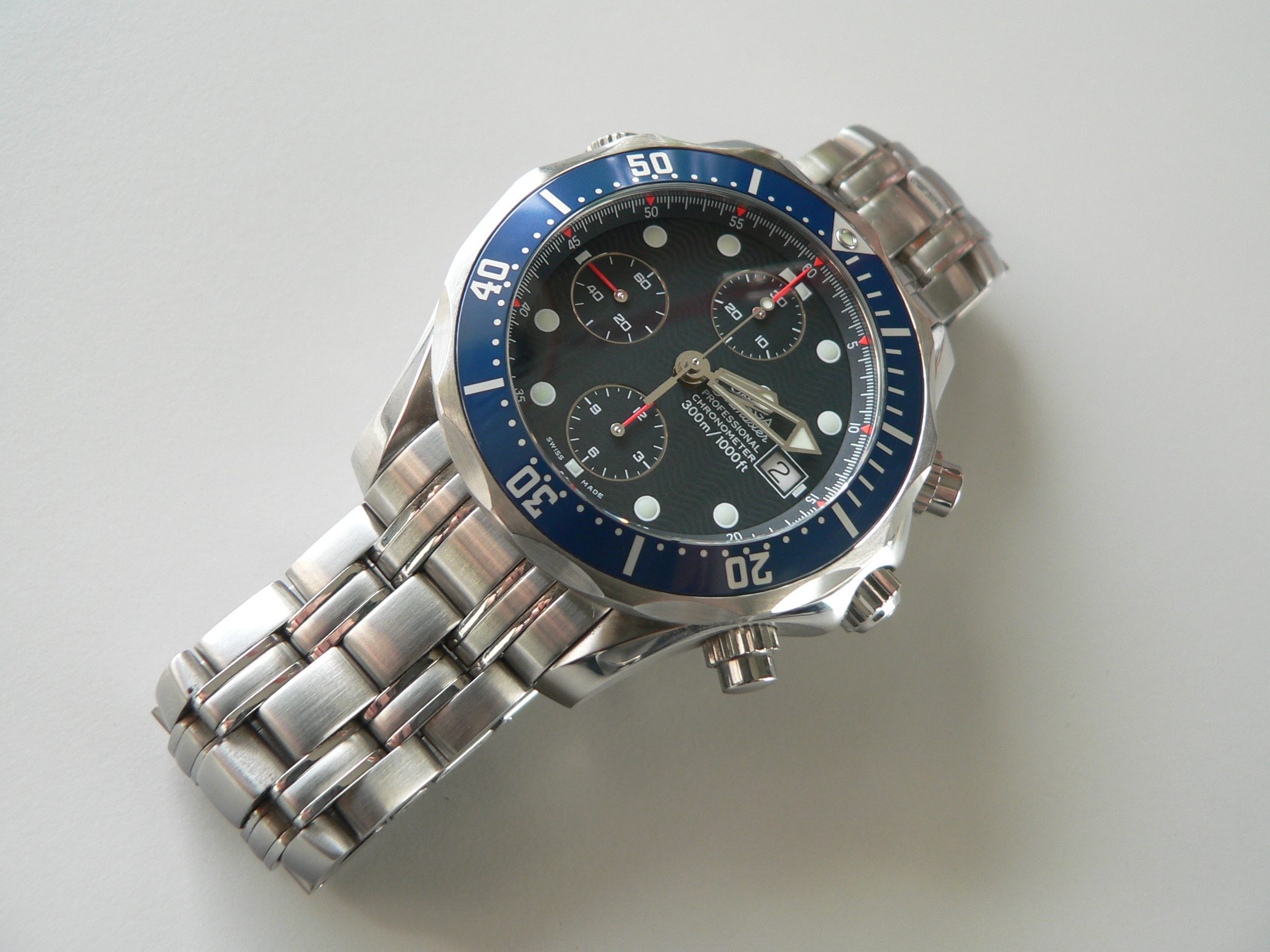
 Photo by Rama, via Wikimedia Commons, CC BY-SA 2.0 fr
 What is vintage Omega?
Omega is a Swiss watchmaker founded 1848 in La Chaux-de-Fonds by Louis Brandt and headquartered in Biel/Bienne since 1880. The vintage market centers on three lineages. The Speedmaster (introduced 1957, ref CK 2915) is the chronograph that NASA qualified in 1965 and that Buzz Aldrin wore on the moon in July 1969 — caliber 321 through 1968, caliber 861 from 1968 onward, caliber 1861 from 1996. The Constellation (introduced 1952) is Omega’s chronometer-grade dress line, signature "Pie-Pan" multi-faceted dial, applied logo, automatic chronometer movements. The Seamaster (introduced 1948) is the dive lineage — Seamaster 300 ref CK 2913 (1957) was the original professional dive watch. Vintage Omega trades in dollars rather than tens of dollars only when references, calibers, and dial originality are documented.
History
Louis Brandt founded the company in 1848 in La Chaux-de-Fonds as an assembly workshop. His sons moved production to Biel/Bienne in 1880 and adopted the Omeganame in 1894 after the calibre 19-ligne "Omega" movement succeeded commercially. By 1900 Omega was one of the largest Swiss producers by volume. The company won precision chronometry trials at Kew, Geneva, and Neuchâtel in the early twentieth century, and supplied military timepieces to the British and other allied forces through both world wars.
The defining decade was 1957. Omega released three professional tools at Basel that year — what collectors now call the "Master Trio": the Speedmaster CK 2915 (chronograph for motorsport), the Seamaster 300 CK 2913 (dive watch), and the Railmaster CK 2914 (anti-magnetic for engineers and scientists). All three ran in-house movements. All three established the references that vintage collectors chase today. The CK 2915 Speedmaster ran caliber 321 — the column-wheel chronograph co-developed with Lemania (Lemania 2310 base) — and carried the broad-arrow hands that distinguish the earliest production.
In 1965 NASA tested the Speedmaster against six other chronographs in conditions ranging from −18°F to 200°F, vacuum, vibration, and acoustic shock. The Speedmaster was the only watch to survive the qualification. NASA issued reference 105.003 (and later 105.012 and 145.012) to astronauts. On July 21, 1969, Buzz Aldrin wore his Speedmaster 105.012 on the lunar surface; Neil Armstrong’s Speedmaster stayed in the Lunar Module to replace the failed onboard timer. Both watches ran caliber 321. The Speedmaster has been on every crewed NASA mission since.
In 1968 Omega replaced caliber 321 with caliber 861 (Lemania 1873 base), a cam-actuated chronograph that was cheaper to produce and easier to service. NASA recertified the Speedmaster with caliber 861 in 1972. Caliber 861 ran through 1996, when it was lightly revised into caliber 1861. The current Speedmaster Professional Moonwatch runs caliber 3861 (Master Chronometer co-axial, 2021). The vintage market treats caliber 321 production (1957–1968) as the historically significant arc; caliber 861 production (1968–late 1990s) as the accessible collector arc; and everything from caliber 1861 forward as the modern lineage.
Signature vintage references
Speedmaster CK 2915 / CK 2998
The CK 2915 (1957–1959) is the original Speedmaster — broad-arrow hands, applied Omega logo, steel bezel, caliber 321. Production was small (fewer than 3,500 units) and original-condition examples are scarce. CK 2915-1, -2, and -3 sub-variants are distinguished by case-back design and bezel detail. The CK 2998 (1959–1962) replaced the broad-arrow hands with alpha hands and introduced the black aluminum bezel. Both are caliber 321. Auction prices: CK 2915 trades $100,000–300,000; CK 2998 trades $40,000–100,000.
Speedmaster 105.003 / 105.012 / 145.012
105.003 (1963–1967, "Ed White") was the reference Ed White wore on the first American spacewalk in June 1965. Caliber 321, straight lugs, no crown guards. 105.012 (1964–1968) added asymmetric lugs and crown guards — the case shape that defines every Speedmaster Professional since. 145.012 (1967–1968) is the last caliber 321 reference; it overlapped 105.012 production briefly. All three are NASA-qualified and were issued to astronauts. Trading range: $25,000–80,000 depending on dial originality and bezel condition.
Speedmaster 145.022
145.022 (1968 onward) is the first caliber 861 Speedmaster Professional and the reference produced through the 1970s and into the 1980s. The watch is mechanically identical to the modern Moonwatch except for the movement and minor dial details. Trading range: $7,000–15,000 for an unpolished original-dial example with full set; $4,000–7,000 for honest wear without papers. This is the entry point to serious vintage Omega collecting.
Speedmaster Mark II / Mark III / Mark IV / Speedsonic
Mark II (1969–1972) is a barrel-cased Speedmaster with caliber 861 — the alternate-cased sibling to the Professional. Mark III (1971) introduced caliber 1040, an automatic chronograph. Mark IV (1973) refined the Mark III architecture. The Speedsonic (1974) ran the f300Hz tuning-fork caliber 1255 — a high-frequency electronic chronograph that bridged mechanical and quartz eras. These references trade $1,500–6,000 and are undervalued relative to the Professional line.
Constellation Pie-Pan ref 14393 / 168.005
The Constellation (introduced 1952) is Omega’s chronometer-grade dress line. The "Pie-Pan" dial — multi-faceted with a stepped outer ring resembling an inverted pie pan — is the signature variant produced through the late 1960s. Reference 14393 (1958–1962) and 168.005 (1962–1966) are the canonical Pie-Pans. Caliber 551 (automatic, chronometer-certified) is the standard movement. Applied indices, applied logo, gold-capped or steel cases. Trading range: $1,500–5,000. Pie-Pans in 18k gold trade $4,000–10,000.
Seamaster 300 ref CK 2913 / 14755 / 165.024
The Seamaster 300 CK 2913 (1957) is Omega’s original professional dive watch — part of the Master Trio. 200m water resistance (despite the "300" name, which referred to a depth rating in feet), broad-arrow hands, naidoh bezel. CK 2913 trades $20,000–60,000. 14755 (1962–1963) introduced sword hands and a black dial. 165.024 (1964–1969) is the long-running production reference, caliber 552 automatic, and trades $5,000–15,000 in honest condition.
De Ville / Geneve dress watches
De Ville (introduced 1967, originally a Seamaster sub-line) and Geneve (1953–80s) are the affordable vintage Omega tier — manual-wind or automatic dress watches in gold-plated or steel cases, often with caliber 552, 565, 601, or 613. Trading range: $400–1,500. The De Ville Mecaquartz (1976) ran the caliber 1310 — a hybrid quartz-mechanical movement with mechanical chronograph and quartz timekeeping circuit. Mecaquartz is undervalued and historically interesting.
The caliber question
Caliber 321 is a column-wheel chronograph based on the Lemania 2310 architecture. Column-wheel actuation gives a softer pusher feel and is generally considered the technically superior chronograph design. Production ran 1946–1968 across multiple brands (Patek Philippe ran the same base architecture as caliber CH 27‑70 in the ref 2499 perpetual chronograph). Caliber 861 is a cam-actuated chronograph based on Lemania 1873. Cam actuation is mechanically simpler and cheaper to produce; the pusher feel is firmer. Caliber 861 ran 1968–1996. Caliber 1861 (1996–2021) is a lightly revised 861. The market premium on caliber 321 over 861 reflects both the technical preference for column-wheel actuation and the historical association with the moon landings.
Dial variants and red flags
Step dial vs flat dial
Pre-1970 Speedmaster dials are "step" dials — the outer minute track sits on a slightly raised step distinct from the central register field. Post-1970 dials are flat. The step is subtle but visible under raking light. Step dials are not uniformly more valuable than flat dials, but the dial type should match the reference: a step dial on a 145.022 produced after 1970 is suspect.
DON and DTM bezels
"DON" (Dot Over Ninety) bezels have the bezel dot positioned above the 90 tachymeter marker. DON bezels were standard through 1970 and command a 30–50% premium over post-1970 DOI (Dot Over Inverted I) bezels on equivalent references. "DTM" (Dot To the Minute) is a less common variant. Bezel inserts are service-replaceable, which means an original DON bezel on a 145.012 is the part most often swapped during service — verify against case-back wear and overall patina.
Applied vs printed indices
CK 2915 had applied indices and applied Omega logo; later references shifted to printed indices and printed logo. Applied indices catch light differently than printed indices and are part of the visual vocabulary of pre-1962 Speedmasters. Constellation Pie-Pan dials retained applied indices and applied logo throughout their production run.
Gilt vs matte / lume aging
Gilt printing (gold-tone, galvanic-plated) appears on some early Constellation and Seamaster dials. Matte printing (white) is standard on Speedmaster after the earliest production. Lume aging tells the dial’s story: radium lume (pre-1963) yellows and may craze; tritium lume (1963–1997) ages cream to caramel; Super-LumiNova (post-1997) stays bright white. A 1965 Speedmaster with bright white lume is a service dial.
Tropical dials
A "tropical" dial is a vintage dial that has aged from black to warm brown from UV exposure and chemical change. Particularly prized on Speedmaster 105.012, 145.012, and Seamaster 300 165.024. Tropical examples can sell at 2–4× the equivalent non-tropical example. Authentication matters because tropical can be induced artificially. Compare patina against case wear and lume aging — a tropical dial with bright lume and unworn case is almost certainly faked.
Red flags
"Professional" upgraded movements.A vintage Speedmaster advertised with a "serviced and upgraded movement" often means the original caliber 321 has been swapped for caliber 861, or that incorrect parts have been installed during service. Caliber should match reference. Verify movement number against the case via the Omega Vintage Information Service.
Polished cases. Speedmaster lugs are brushed on top and polished on the chamfer. A uniformly polished case has lost its case geometry. Look at the lug cross-section: a sharp transition between brushed top and polished chamfer is original; a smoothly blended transition is polished. Heavy polishing reduces value 50–70%.
Refinished dials. A refinished dial has been removed from the watch, stripped, and reprinted. Indicators: lettering that sits flat against the dial surface rather than embedded in lacquer; printing weight that varies between elements; lume that’s been replaced with non-period material. Refinished dials cut value 60–80%.
Mismatched bezel and dial era. A DON bezel on a flat-dial 145.022, a faded tropical bezel on a service-dial Speedmaster, or a Mark II bezel on a Professional case all indicate parts swaps. Era should match across components.
Price tiers (2026 secondary market)
- Pre-Moon Speedmaster — CK 2915 $100,000–300,000; CK 2998 $40,000–100,000; 105.003 / 105.012 / 145.012 $25,000–80,000
- Caliber 861 Speedmaster — 145.022 (1970s) $7,000–15,000; 145.022 (1980s) $4,000–8,000; Mark II / III / IV $1,500–6,000
- Constellation Pie-Pan — steel/gold-cap $1,500–5,000; 18k gold $4,000–10,000
- Seamaster 300 — CK 2913 $20,000–60,000; 14755 $8,000–20,000; 165.024 $5,000–15,000
- De Ville / Geneve — manual-wind dress $400–1,500; Mecaquartz $600–1,800
- Auction premiums for documented NASA-flown examples or tropical dials run 2–5× the standard range.
What’s worth knowing
Vintage Speedmaster vs current production. The current Speedmaster Professional Moonwatch (caliber 3861, Master Chronometer, 2021 onward) is mechanically superior to any vintage Speedmaster — better timekeeping, better magnetism resistance, co-axial escapement. The vintage market is not paying for performance. It is paying for reference, dial originality, and historical association. A 1969 145.012 trades at 4–6× a current 3861 Moonwatch despite being mechanically inferior. The market is buying the moon, not the chronometry.
The 1968 NASA recertification matters.NASA recertified the Speedmaster with caliber 861 in 1972, which means caliber 861 watches were also flight-qualified. The historical narrative that "only caliber 321 went to the moon" is true for Apollo 11 specifically, but Skylab (1973), Apollo-Soyuz (1975), and the Space Shuttle program all flew caliber 861 Speedmasters. This matters when valuing 145.022 examples that flew on later missions.
The Omega Vintage Information Service is the authentication anchor.Located in Bienne, the service issues "Extract from the Archives" certificates that confirm production date, original specification, and original destination market. Roughly $150 and 4–6 weeks turnaround. Any vintage Omega over $5,000 should have an Extract or be priced in expectation that the buyer will order one. An Extract is not a guarantee against parts swaps but is the strongest available paper trail.
Where to buy. Established dealers with vintage Omega specialty: Analog/Shift, Wind Vintage, Watches of Switzerland Pre-Owned, Bonham’s, Phillips, Christie’s, Sotheby’s, Hodinkee Shop pre-owned, and Omega’s own Vintage Boutique program (selected references restored to factory specification). Avoid eBay listings without dealer reputation and Chrono24 listings without verified dealer credentials. Any seller who can’t produce service history, answer detailed questions about caliber and reference, or commission an Omega Extract should be passed.